
Free Zone vs Mainland in Dubai for E-commerce


If you run an e-commerce business and you are weighing Dubai as your base for the UAE, the wider GCC, or the Middle East and Africa region, the same handful of questions keeps coming up. Free zone or mainland? What is a bonded free zone and does it actually save money? Which business activities can I register? How much should I build in-house on day one? And what do founders who land here tend to get wrong?
We put those questions to someone who answers them for a living. On Let’s Talk eCommerce, our host Anurag Byala, Founder and CEO of Techies Infotech, sat down with Faisal Jassim, Senior Director at Dubai CommerCity (DCC), the region’s first free zone built specifically for digital commerce. Faisal leads sales at DCC. Before that he worked at JAFZA, HSBC and Deloitte, which means he has seen how companies operate from the audit desk, the bank, the regulator and the zone operator.
This article turns that conversation into a written playbook. It follows the order of the episode, keeps Faisal’s reasoning intact, and adds what it means for the commerce platform, payments, logistics and localization decisions that sit behind a UAE launch. Full disclosure: Techies Infotech is headquartered at Dubai CommerCity, so we see this ecosystem from the inside too.
Key takeaways from the episode
Why Dubai? The answer starts with people, not tax
Anurag opened with the question every relocating founder gets asked: why the UAE, and why Dubai? He has run his business from Dubai for six years and described the growth he has seen as something he could not have imagined elsewhere.
Faisal’s answer was not about incentives. He pointed to a book he is reading, Peak Human, which looks at what helped civilizations rise and what led to their decline. The pattern he keeps noticing is the same across the Greeks, the Romans, the Abbasids, the Dutch and the Renaissance: multicultural societies where people arrive, call the place home and add value. Free markets, tolerance and openness to different backgrounds are part of the recipe.
Lifestyle is an economic factor
When Faisal talks to startups about why they should establish in Dubai instead of older, more established startup hubs that had a few decades’ head start, the answer comes back to lifestyle. He compared it to how the Bay Area became an entrepreneurial hub: quality of life and education drew talent in. People who feel welcome and comfortable are in a better mindset to build and create value.
A trading city for centuries
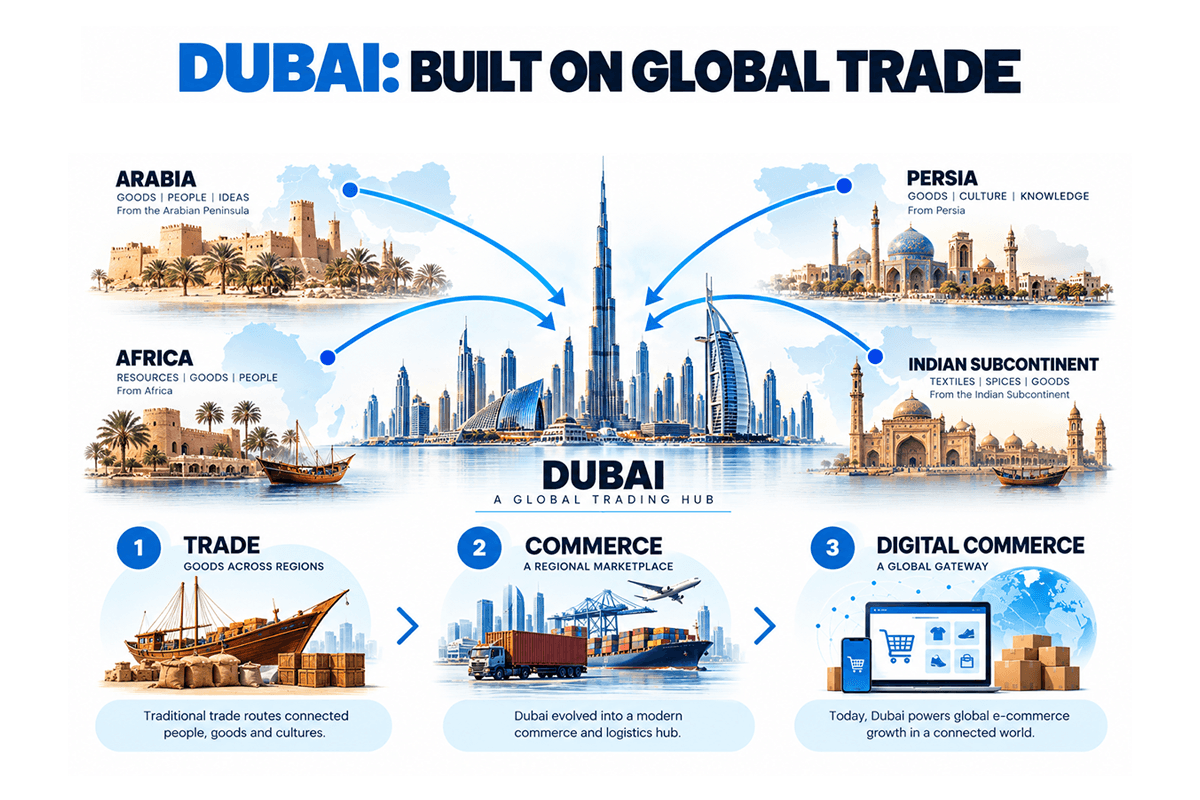
Faisal also pushed back on the idea that Dubai is a 25 or 30-year-old story. Old accounts of the city describe a light-touch, free-market approach to trade. Merchants from Arabia, Persia, the Indian subcontinent and Africa came here to trade. In his words, openness to trade is part of Dubai’s DNA, and it still shapes how regulators like DCC and JAFZA think. The core question behind their decisions is how to make life better for the merchant, the trader and the person adding value. Their role is to provide a conducive environment, not to hinder.
Talent with breadth and depth
For anyone building a team, he highlighted a pool that runs from entry-level roles to the CEO seat. Anurag added the cultural dimension: in a single day a Dubai-based founder can speak with customers or partners in the US, the UK and across the Arab world. That exposure is a learning advantage in its own right.
“It is not about hindering. We are there to provide a very conducive environment to grow.”Faisal Jassim, Senior Director, Dubai CommerCity
Dubai as the gateway to the GCC, MEA and beyond
“Gateway to the GCC” is a phrase everyone has heard. Faisal explained what it means in practice. A company expanding across the region has two options. It can enter each market separately, hiring staff, getting licences and setting up facilities in every country. Or it can establish in Dubai and manage regional operations from one place.
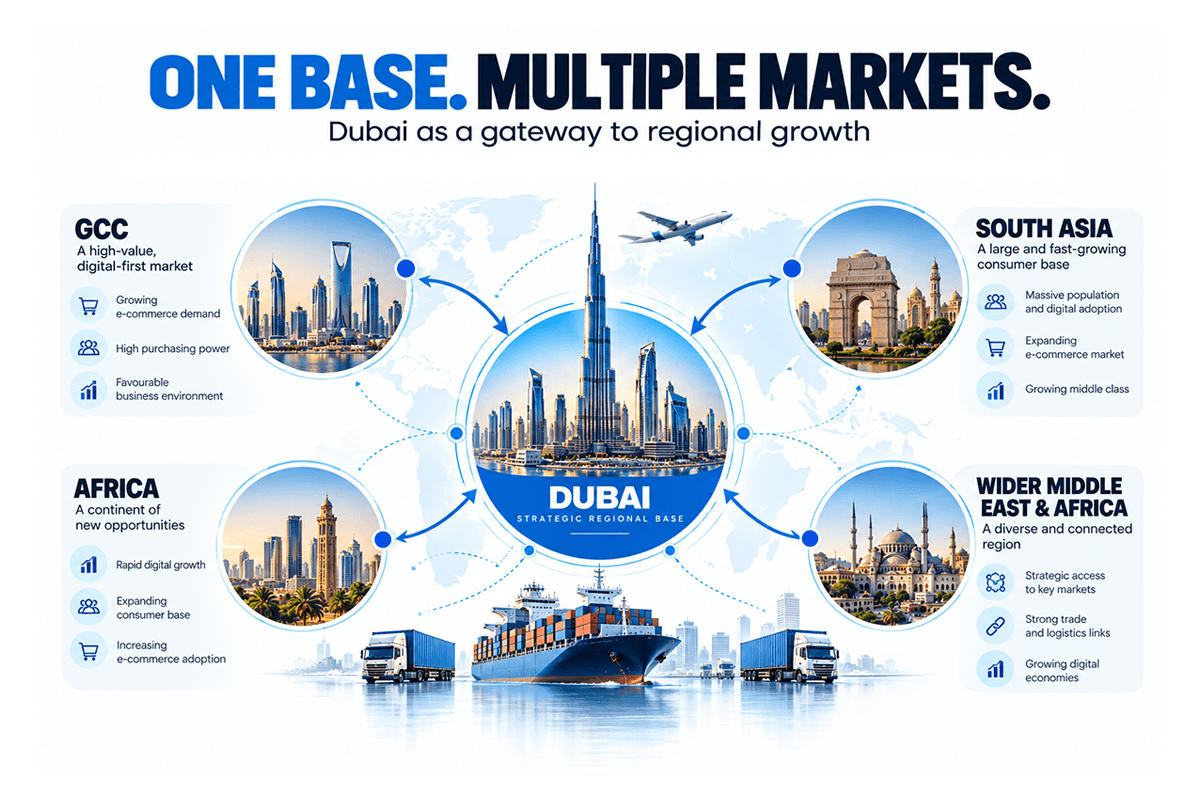
He sees this with traditional sectors such as automotive and logistics, and increasingly with newer digital companies. They want fewer moving parts. The GCC is one part of the opportunity. Africa and South Asia are within easy reach. He noted that a flight from Dubai to Mumbai is shorter than one from New Delhi to Mumbai, which tells you how close the subcontinent is.
Companies that set up in Dubai to serve other countries
Faisal described a type of founder he meets often: entrepreneurs from jurisdictions where infrastructure, both hard and soft, is still developing. Their ambitions are bigger than their local environment allows, so they set up in Dubai and serve their home region or neighbouring countries from here. The airports, seaports, rail and digital infrastructure Dubai builds are meant for the broader region, not only the UAE.
What COVID revealed
He pointed to the pandemic as a stress test. A large share of regional supplies, including PPE, food and medicine, moved through Dubai. He recalled conversations with UNICEF, who described Dubai as one of their major global hubs for distributing aid and equipment. For e-commerce brands, the lesson is straightforward: this is a logistics base that has been tested under real pressure.
Digitization lowers cost for everyone
Processes that used to be manual have been digitized, which cuts cost for the end user, reduces the manpower governments need, and makes the whole process more efficient. Faisal contrasted this with jurisdictions that did not invest early and are now catching up. As one practical example, he noted that opening a bank account, which used to take weeks or months for some companies, can now happen within days, so a founder can start trading and adjusting sooner.
A free market produces new commerce infrastructure
Faisal credited the free market for the services that have appeared around e-commerce in the UAE:
The result, in his words, comes down to mindset. When you allow people to create, they build solutions, and the market benefits from the options.
Free zone vs mainland: how to actually decide
This was the section many viewers had asked for. Anurag said he receives a steady flow of LinkedIn messages asking about the difference between a free zone and the mainland, and what kinds of activities can be registered. Faisal started by correcting one word in the question. He does not like the word “mandatory.” It is a business decision, and he approaches it with honesty rather than a sales pitch.
Designated and non-designated free zones
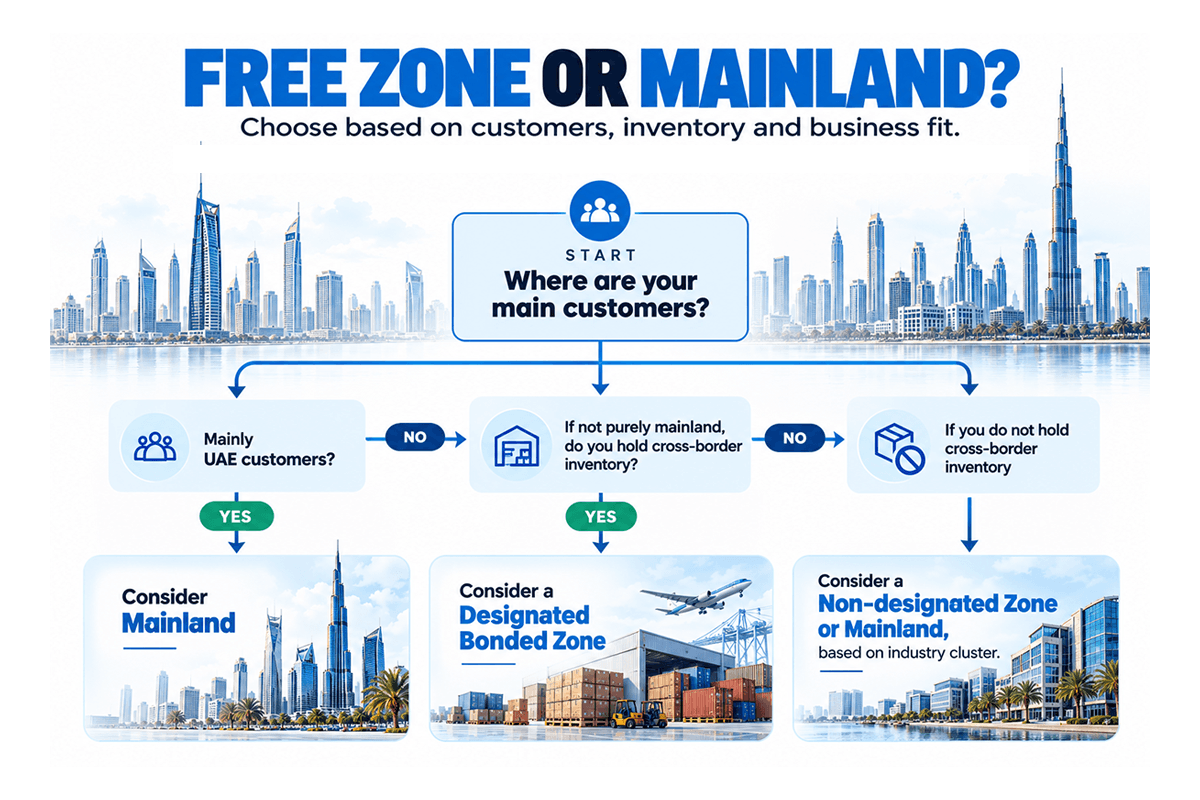
Faisal’s first point was that free zones are not all the same. Broadly, there are two types, defined from a tax authority perspective.
Designated free zones Non-designated free zones Customs status Customs-bounded. Movement of goods in and out is monitored and restricted. Not customs-bounded in the same way. Customs and tax implications Yes. Moving goods out of the zone triggers customs and tax treatment. Handled more like the mainland for goods movement. Examples Faisal gave Dubai Airport Free Zone, JAFZA (Jebel Ali Free Zone), Dubai South, Dubai CommerCity DMCC, Dubai Internet City, Dubai Media City, D3 (Dubai Design District) Typical fit Companies that hold and move inventory, especially with a cross-border element. Service, creative, media, finance and trading businesses that do not rely on bonded storage.
The decision logic Faisal walks clients through
He also explained why free zones used to have an easier pitch. When zones such as JAFZA were established around four decades ago, they came with advantages such as 100% foreign ownership. UAE laws and economic policy have since liberalized, and founders can now establish directly on the mainland. That shifted the free zone conversation from ownership toward fit, infrastructure and ecosystem.
Why the cluster matters
According to Faisal, the right zone often follows your industry:
The value of a cluster, he argued, includes what you absorb just by being in the environment. Your suppliers, vendors and customers are close. The talent pool is larger because many companies in the same field sit nearby. The authority in the zone is geared to that industry, so regulations and improvements are built with it in mind. And you see peers who started where you started and where they have reached, which gives you ideas for the next piece of your own business. Faisal described this as a synergy mindset, where one plus one equals more than two.
He gave a simple example from the studio where the episode was recorded. A company that begins by offering podcasting services sees neighbours launch YouTube channels and related services, and the proximity sparks new directions.
Bonded free zones and working capital, explained with sneakers
Anurag asked Faisal to explain a bonded free zone for a layperson who wants to import goods and distribute both inside and outside the UAE. Faisal used an example of a sneaker brand, which makes the logic easy to follow.
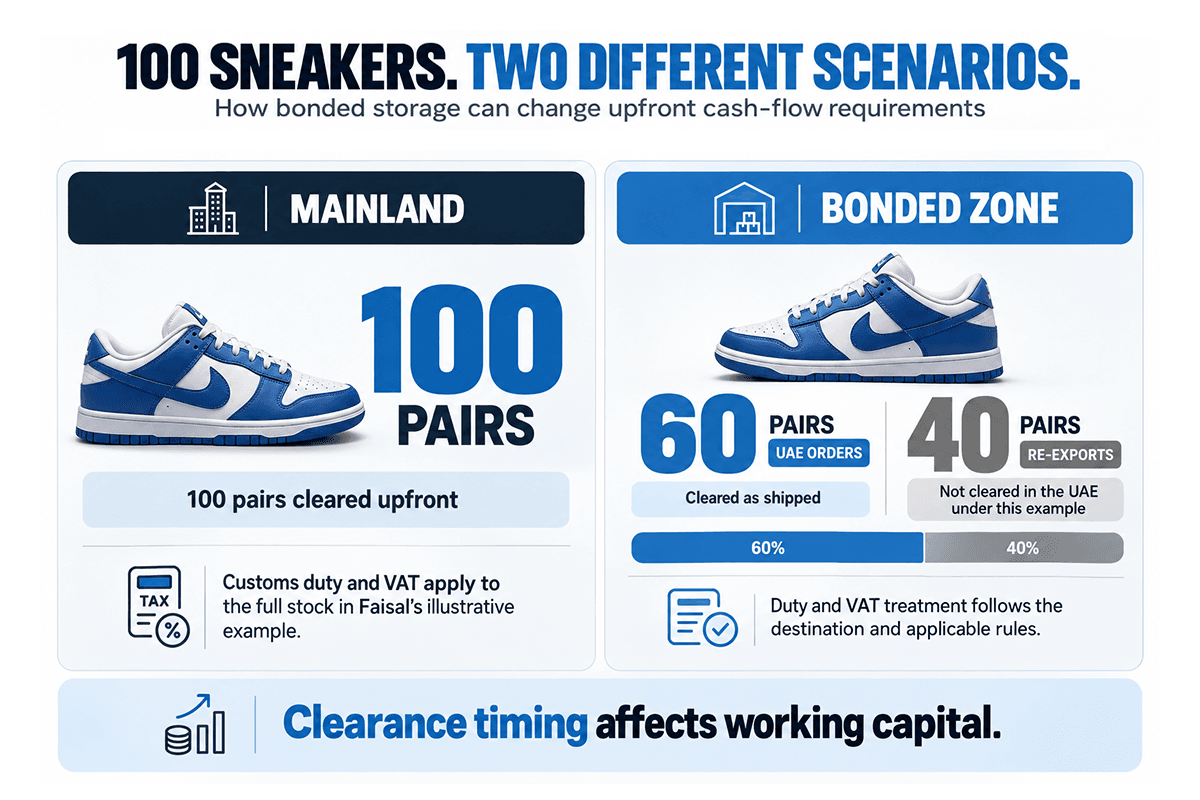
Imagine you import 100 pairs of sneakers and sell them online. You expect 60 to go to customers in the UAE mainland, and the other 40 to be re-exported to other countries.
Scenario What happens to the 100 pairs Cash impact on day one Mainland, full stock You bring in the full stock and pay customs (5%) and VAT (5%) on all 100 pairs, around 10% in Faisal’s example. Cash is tied up in duties on stock that may leave the country. Designated bonded zone Stock is held in the bonded warehouse. As each of the 60 mainland orders ships, you clear customs and VAT on those pairs only. The 40 pairs to be re-exported never carry duty and VAT through your books.
For the 40 re-exported pairs, Faisal imagined 10 going to Saudi Arabia, 20 to Egypt and 10 to India. Customs and VAT on those pairs are cleared in the destination countries, so you do not account for them in the UAE.
Faisal was clear that VAT and duties paid up front can often be recovered. His point is about timing. Between importing the goods and selling them, and then waiting for the refund, could be days, weeks or months. For a small or mid-sized company, that delay is a working capital cost. A bonded warehouse is a cash flow management tool as much as a compliance structure.
“If your main business is the mainland, it is probably easier to go to the mainland. But if you do have a cross-border element, from an inventory and working capital management point of view, it makes sense to be within a zone with a bonded warehouse.”Faisal Jassim, paraphrased from the episode
Note that the 5% customs and 5% VAT figures were used as an illustrative example in the conversation. Duty treatment depends on the product and the situation, so confirm rates and rules with the relevant authority before modelling your own numbers.
Inside Dubai CommerCity: built for e-commerce from the start
Anurag asked Faisal what Dubai CommerCity was built for and what its DNA is.
The origin story
The idea for DCC came together around 2015 and 2016. Faisal pointed to three ingredients that were already in place: high mobile and smartphone adoption, high internet penetration, and a mature logistics and trade infrastructure, because Dubai is a re-export hub for the wider region. Those three together made it a matter of time before e-commerce took off. DCC was designed to foster what was then a nascent industry, with a focus on startups and small and medium-sized businesses. It opened physically in 2020, with the first building established in 2020 to 2021, and it is still being built out.
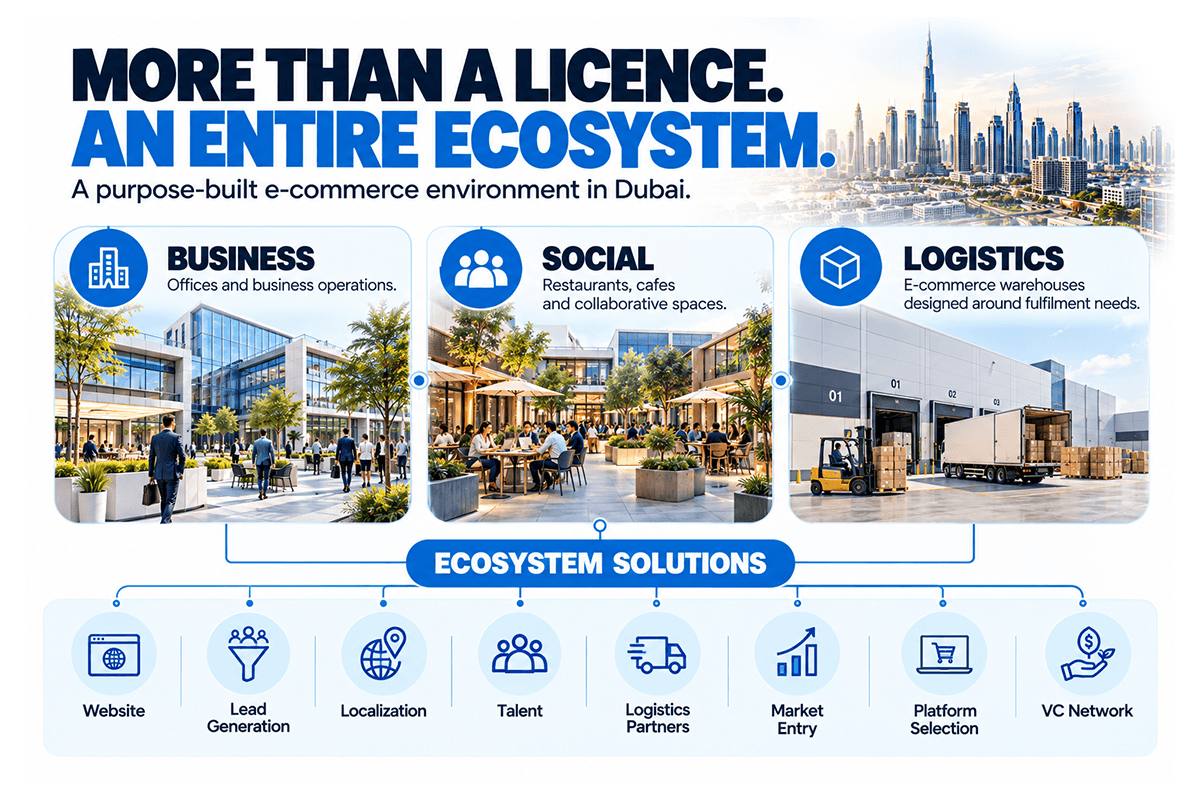
Three clusters
The warehouse point is worth noting. Faisal stressed that warehouses are not all equal. Some are designated for manufacturing or general trading. DCC’s are built around how e-commerce operations actually work.
Ecosystem solutions: more than a lease and a licence
The part Faisal emphasised most was the ecosystem solutions function. A lease and a licence are only step one. After that, an e-commerce company still needs to launch a website, generate leads, localize content, find talent, choose logistics providers, work out market entry strategy and decide which local platforms to use.
DCC runs a dedicated team with dedicated KPIs to help with this. When a client arrives, the team listens to their pain points and, most of the time, already has partners who can help. Examples he gave included:
Faisal contrasted this with zones that treat introductions as a goodwill gesture. His view is that a dedicated function with accountability turns it into a sustainable advantage. DCC is also building out a venture capital network for companies that have proven their model and need funding to reach the next level.
He was also candid about fit. When a chemical manufacturer approached DCC, he told them he would be happy to welcome them but that other zones are better suited. DCC’s focus is digital commerce in the broad sense, including new media, AI, blockchain and machine learning.
Business activities: what you can register and what needs extra approval
DCC follows ISIC Revision 4, the international standard for classifying economic activities. Its list contains thousands of activities, and it is not fixed. If a company needs an activity that is not on the list but exists elsewhere, DCC will add it.
Some activities need enhanced due diligence or special approvals. Faisal avoids calling them “restricted.” His example was pharmaceuticals, which require approval from health authorities. DCC helps clients obtain these approvals, and in some cases the team has physically gone with the client to the relevant authority to explain the business. He described the support as hand-holding from A to Z.
Are regulated categories harder to operate?
Anurag pushed on this. Is it easy to operate in a sensitive category such as food and nutrition or beauty and wellness, compared with something like furniture? Faisal answered with a proverb: a journey of a thousand miles starts with a single step. Founders usually have huge goals, such as becoming the next Amazon or the next Noon. His advice is to break that goal into bite-sized milestones and not be intimidated by approval processes or activity descriptions.
Start small: the 12-month horizon
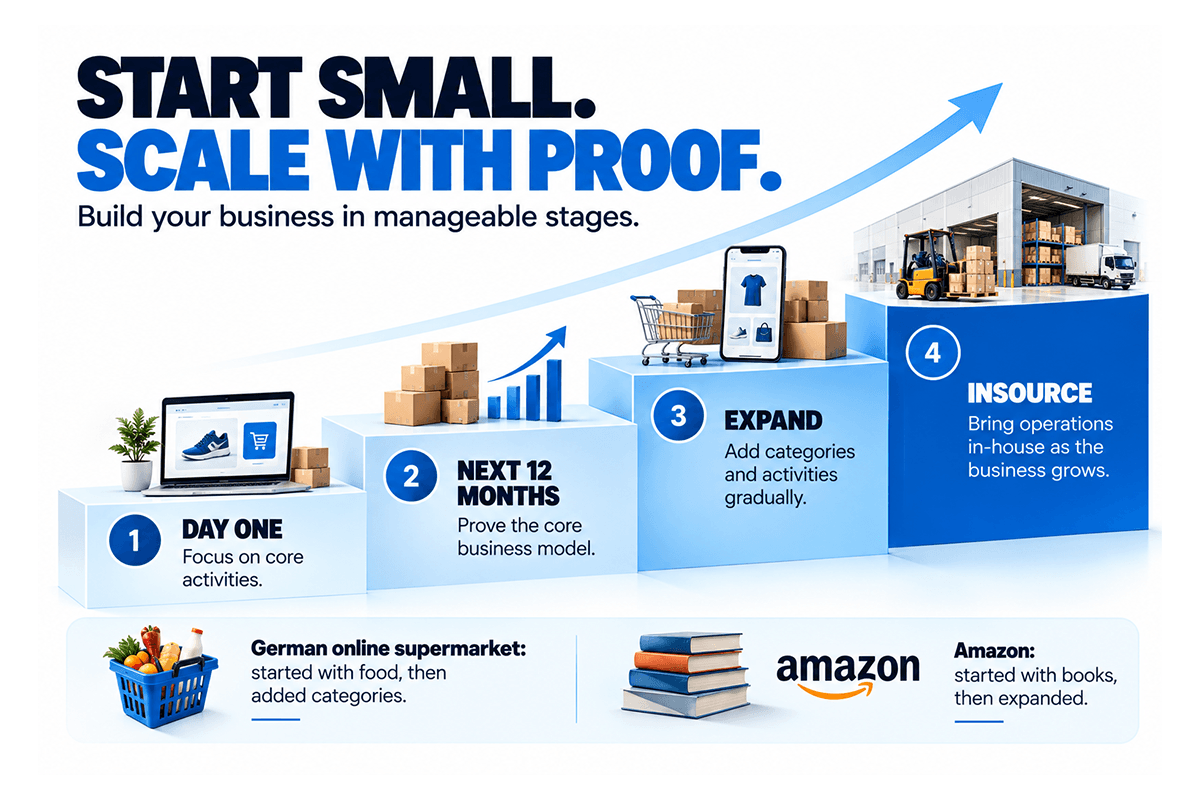
The most repeated idea in the episode was to think in 12-month horizons. Choose the activities that fit the next 12 months. Adding activities later is simple, so there is no need to register everything on day one and use a fraction of it.
The online German supermarket
Faisal shared a real client story. A company wanted to become an online German supermarket, selling food, snacks and also non-consumables such as shampoo, soap and toothpaste. The approval processes for food and for personal care products differ. Faisal suggested starting with German snacks and food that were not easily available in the UAE, getting that right, setting up the bank account, hiring the team and registering the trade name, and then adding other categories. The client took the advice, started with food, added categories over time and is now an operating, growing business.
The Amazon lesson
He also pointed to Amazon, which began by selling books online and nothing else. It added products gradually and now operates in cloud and AI. They started somewhere, worked in bite-sized milestones and ended up where they did.
“Do not bite off more than you can chew and eventually choke.”Faisal Jassim
Anurag added a line from his own mentor: you do not eat the entire elephant in one go, you eat it bite by bite. He noted that many founders want everything at once, when a business actually grows incrementally and milestones keep you better placed.
Why a rigid ten-year plan can hurt
Faisal added a counterpoint. Assuming you have everything figured out before you have launched is a kind of overconfidence. Once you start, you find tangents, new opportunities and pivots. His advice: enjoy the journey, find your own way, stay nimble. A plan that locks in where you want to be in ten years restricts you, and most founders end up somewhere they did not expect, often in a better place.
Outsource first, insource later
Faisal sees many businesses try to bring everything in-house from day one. His advice is to outsource as much as you can and focus on the core business.
His example: if you make jackets, focus on making jackets. You probably do not need your own warehouse because your inventory may fit in a small room. You do not need a payroll full of people doing logistics, financing and accounting. Once the core business is working, begin insourcing pieces one at a time, until eventually, if it makes sense, you hold the full chain in-house.
For commerce teams, this maps neatly onto the way platforms and integrations are usually phased. Start with a lean storefront and managed logistics, then bring order management, fulfilment and finance workflows closer as volume justifies it.
Three things to do if you land in Dubai tomorrow
Anurag asked for the top three recommendations for a founder arriving in Dubai. Faisal noted that people rarely ask this outright and often learn the answer the hard way.
1. Research first, with a calm approach
Keep the drive to start, but approach it calmly. He used a carpenter’s rule: measure ten times and cut once, not measure once and cut ten times. Understand how the market functions and how society works, because a great deal of business here comes from social connections. Network, socialize and listen. You may arrive with a hunch about your product or positioning, and conversations can surface ideas or pivots you had not considered.
2. Do not be penny-wise and pound-foolish
Faisal has heard many stories of founders who saved a small amount and paid for it later. His example was logistics. Company A is established, experienced in last-mile delivery and contract logistics, and priced in the middle or slightly higher. Company B offers the same services on paper at a lower price. Founders who choose B to save money sometimes damage client relationships when B does not deliver.
The same argument applies to zones. Clients tell him that other zones are cheaper than DCC, and his reply is that the decision comes down to value for money. He is not advocating the most expensive option. He is asking founders to understand what they are getting in return. If you pay below market for something that does not work, you end up paying twice, because you still have to pay the next provider properly.
3. Take content localization seriously
Faisal cited the Uber and Careem story. Without getting into the business case, his point was that Careem, before it was acquired by Uber, resonated strongly with regional customers because it understood the market and knew how to connect with its end user.
Many founders assume that because English is widely used in the UAE, Arabic is optional. Faisal considers that view limited even for the UAE, and it does not hold in Saudi Arabia, Egypt, Kuwait and other markets. Localization, in his view, covers language, customs, nuance and the social aspects of how people buy. With so much choice available, customers go with the brand whose product, story and messaging resonates with them.
What localization looks like on a GCC storefront
Anurag brought his own research to this point. His doctorate examined consumer behaviour on e-commerce pages in the UAE and GCC. One finding that stands out: brands that come from outside the region are often influenced by Western consumer behaviour models, which differ from how customers in the region think and shop.
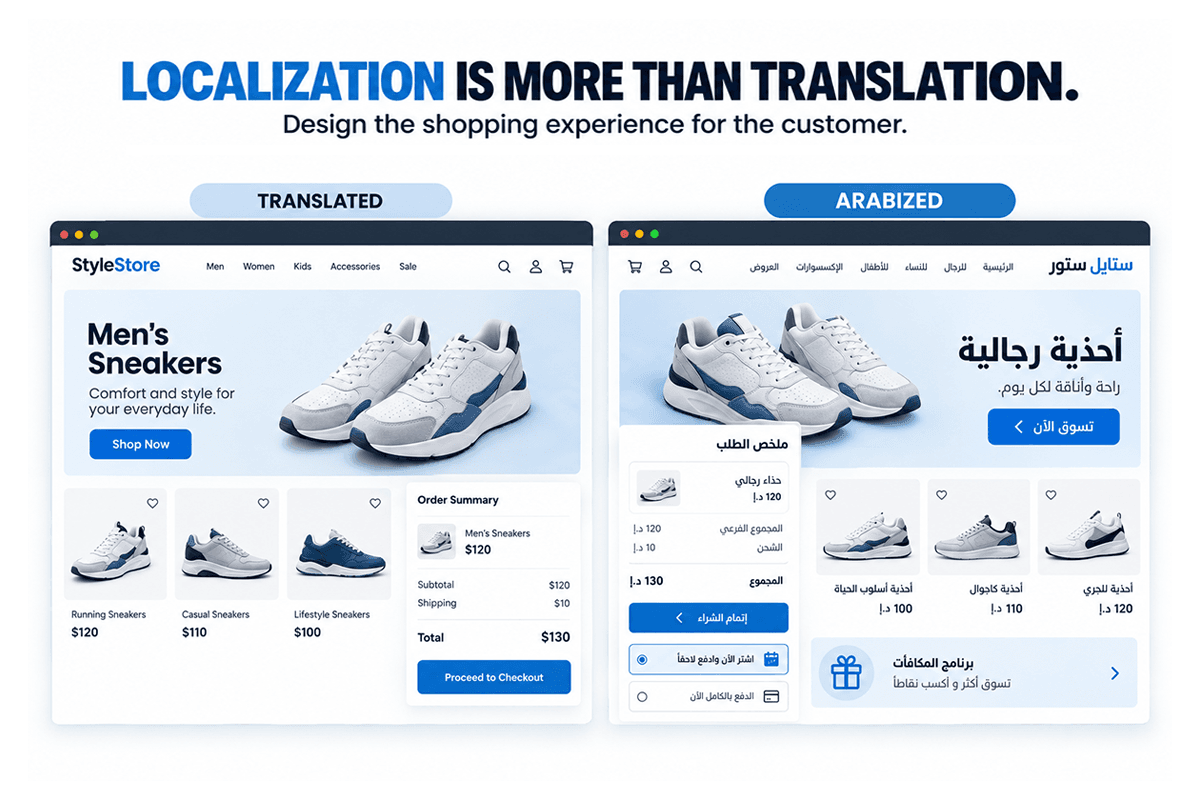
When he talks about localization, he means the Arabization of the entire experience, not just translated copy. That includes:
Brands that skip this work, he warned, will struggle sooner or later, which is a big reason local homegrown brands have done well. They understand consumer psychology in the region.
If you are mapping this to a platform build, the practical checklist is clear: Arabic-first content operations, RTL theme support, payment and BNPL integrations, regional delivery options and promotions logic that reflects local buying behaviour. These are decisions to make at the start of a Shopify Plus, Adobe Commerce or VTEX project, not after launch.
Where Faisal sees the UAE heading over the next 24 months
To close, Anurag asked where Faisal sees the UAE in the next 24 months. He said he is very bullish on e-commerce and digital commerce in particular, and gave several reasons.
Success stories create more success stories
He referred to the so-called PayPal mafia, the group of founders who emerged from PayPal and went on to build and fund other companies. That success inspired others. Faisal sees a similar effect in Dubai and the UAE. When he asked founders in the post-COVID reopening why they were leaving larger, more established economies to start something here, a common answer was that they knew people who had come to the UAE and made it, and they wanted to do the same. Each success story feeds the next.
AI levels the playing field
Faisal acknowledged that talking about AI can sound like a cliche. His view is that it is a net positive that frees up the human mind. He described preparing a leadership presentation that would once have taken hours of alignment, research, colour coding and branding. Now he can focus on messaging. For e-commerce, the same logic applies across content, operations and customer experience, and it makes it easier for a small team to start a real business.
Hard and soft infrastructure keep growing
The hard infrastructure is visible: ports, railways, roads, airports. Faisal stressed the soft infrastructure as well: regulations, authorities and rules that are designed to help companies establish and grow. He mentioned the UAE’s growing list of Comprehensive Economic Partnership Agreements, more in progress, and double taxation treaties. And he noted that anyone with a good idea can find investors. He and Anurag agreed they could name at least two dozen venture capital firms off the top of their heads, with hundreds more in the market.
“The limit of a person or a company’s ambition is only theirs. The hard infrastructure is already there to use.”Faisal Jassim, paraphrased from the episode
What is coming next at DCC: micro-storage and micro-fulfilment
Faisal ended with news that Anurag called a potential game-changer. DCC is launching what Faisal described as a first of its kind in the market: micro-storage and micro-fulfilment units designed for e-commerce.
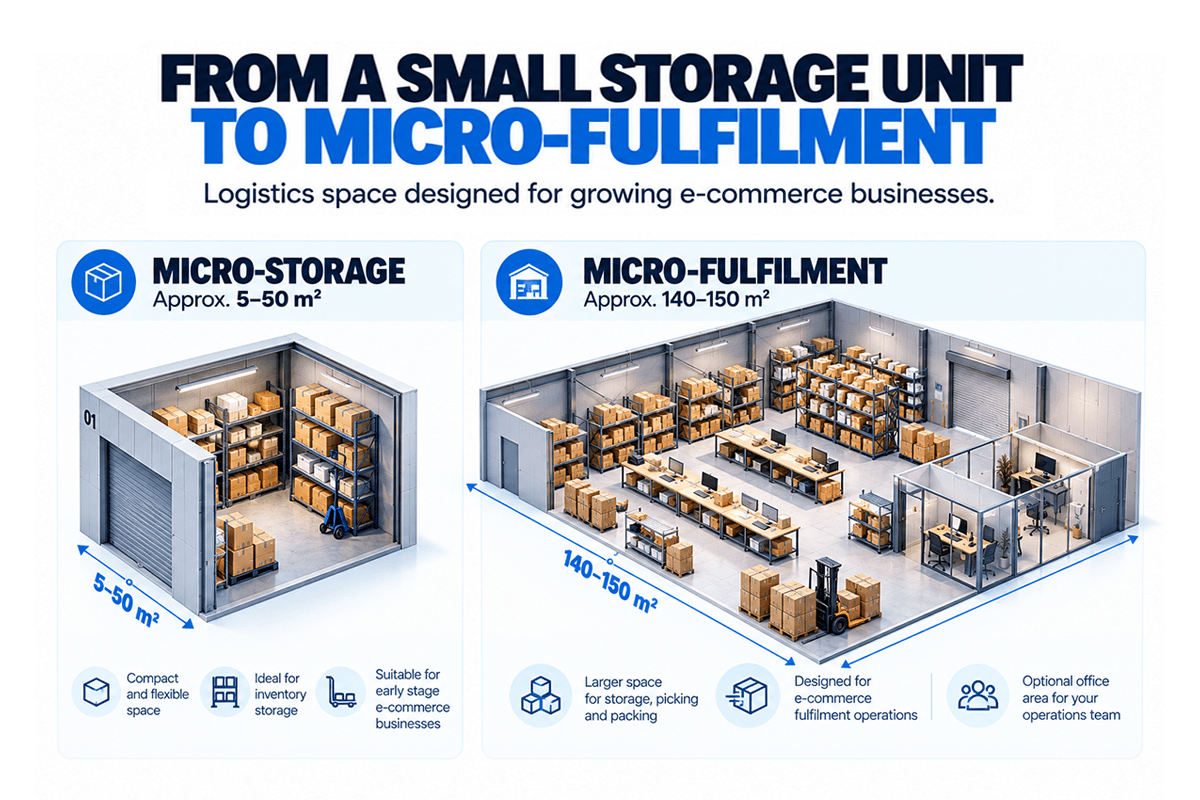
The problem it solves
Many e-commerce startups store inventory in a guest room, bedroom, living room or kitchen. The next step up is a warehouse, and the starting size of a warehouse is out of reach for many startups. In Faisal’s view the jump can bankrupt businesses that otherwise have potential.
What DCC is offering
Unit type Size Who it is for Micro-storage units Around 5 or 10 sq m up to 50 sq m per unit. Multiple units can be combined. E-commerce startups, and companies that support e-commerce fulfilment. Micro-fulfilment units Around 140 to 150 sq m. Temperature controlled, with the option of a small office. Small e-commerce enablers, last-mile and contract logistics providers, and growing brands.
Faisal said the units are meant to give founders breathing room: space to formalize an informal business, obtain licences, put their house in order and then use ecosystem solutions to grow. As for timing, he said the first units were expected to come online around the end of January 2027, speaking from memory in the episode, so check with DCC for the current schedule.
Why this gap exists
DCC’s research found plenty of storage units, but they are mostly built for individuals moving house or small businesses such as a gym storing equipment. Nothing was geared specifically to e-commerce. Likewise, 140 square metres of ready-to-use fulfilment space with the infrastructure already in place is brand new in a market where the norm is larger, 300 to 400 square metre footprints. Faisal’s view is that good ideas tend to be simple, and that this could open a whole new category of e-commerce infrastructure.
His hope is that companies start at DCC and eventually graduate, growing outside it and taking what they learned with them.
A practical playbook for e-commerce brands entering the UAE
Pulling the episode together, here is a working checklist you can take into your own planning.
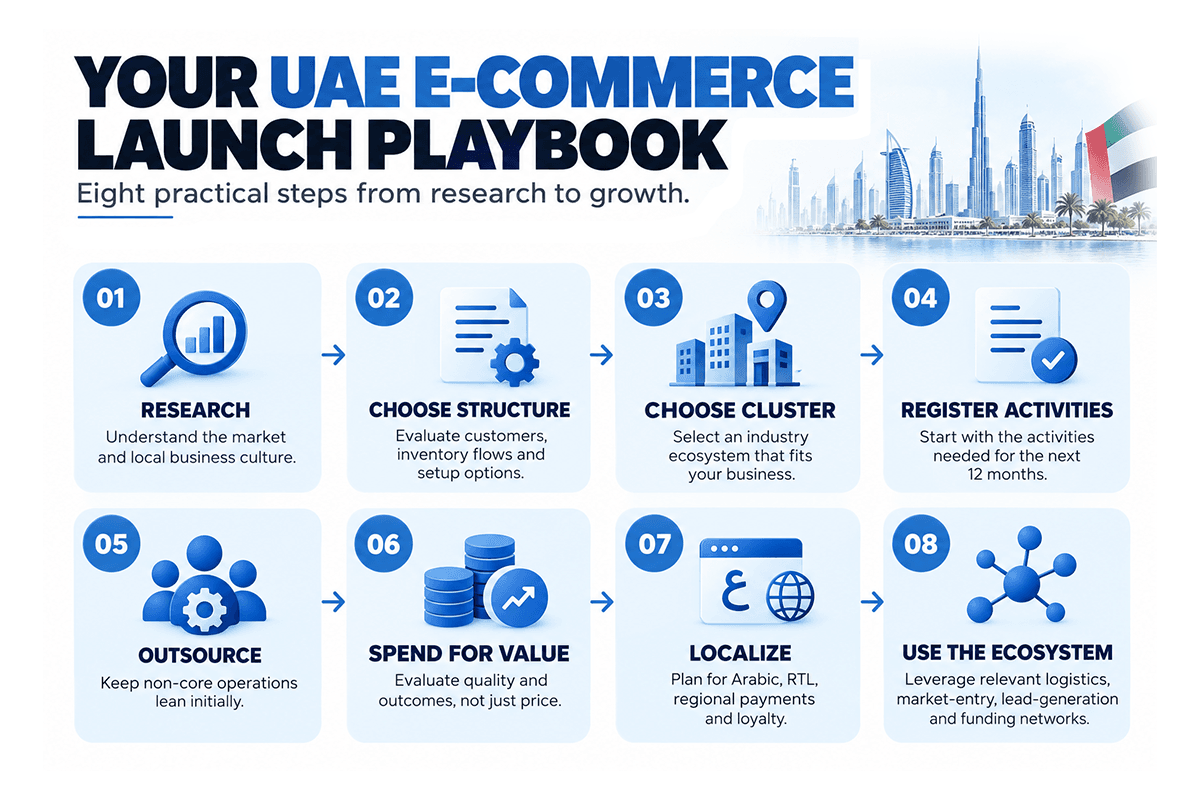
Step Key question What Faisal advised 1. Research Do I understand how this market and society work? Measure ten times, cut once. Network and listen before committing. 2. Choose structure Where are my customers and does my stock cross borders? UAE-focused: mainland. Cross-border with inventory: consider a bonded designated zone. Otherwise a non-designated zone or mainland. 3. Choose cluster Which zone gives me suppliers, talent and peers in my field? Pick the zone whose cluster matches your industry. 4. Register activities What do I need in the next 12 months? Start with the core activities. Add more later. 5. Outsource What is not my core business? Outsource logistics, finance and storage first. Insource gradually. 6. Spend for value Am I comparing price or value? Do not be penny-wise and pound-foolish. 7. Localize Does my experience feel native to the customer? Arabic, RTL, BNPL, loyalty and cultural nuance, especially for Saudi, Egypt and Kuwait. 8. Use the ecosystem Who can shortcut my trial and error? Use the zone’s partner network for logistics, lead generation, market entry and funding.
What this means for your commerce stack
Setting up the entity is one half of a UAE launch. The other half is the commerce platform and integrations that sit on top of it. At Techies Infotech, working from Dubai CommerCity, the two mistakes Faisal described, building everything at once and choosing the cheapest option then paying twice, map directly onto platform projects.
A few translations from the episode into platform decisions:
Frequently asked questions
What is the difference between a free zone and the mainland in the UAE? Faisal Jassim frames it as a business decision. If your customers and catalogue are mainly in the UAE, the mainland is usually simpler. Free zones make more sense when your industry cluster, bonded storage or cross-border trade adds value. Free zones also differ from each other, so the specific zone matters.
What is the difference between designated and non-designated free zones? Designated zones are customs-bounded, so movement of goods in and out is restricted and has customs and tax implications. Examples named in the episode were Dubai Airport Free Zone, JAFZA, Dubai South and Dubai CommerCity. Non-designated zones, such as DMCC, Dubai Internet City, Dubai Media City and D3, are not customs-bounded in the same way.
What is a bonded free zone and how does it help e-commerce sellers? A bonded free zone lets you hold imported stock without clearing customs and VAT on all of it up front. Only the goods sold to the mainland are cleared as orders ship, and re-exported goods are cleared in their destination countries. That improves working capital because you are not tying up cash in duties on stock that may leave the country.
Which free zone is built for e-commerce in Dubai? Dubai CommerCity is the region’s first free zone for digital commerce. It combines e-commerce-ready warehouses, offices and social spaces with an ecosystem solutions team that connects tenants to logistics, lead generation, market entry and funding partners.
Can I add business activities after I set up? Yes. According to Faisal, adding activities later is easy. He recommends registering only the activities you need for the next 12 months and expanding as the business grows.
Do I need to outsource or build everything in-house? Faisal recommends outsourcing as much as possible at the start, including logistics, financing and accounting, so you can focus on the core business. Bring functions in-house gradually as the core business matures.
Do I need Arabic content if I am only selling in the UAE? Faisal considers relying on English alone to be limited even in the UAE, and it clearly does not work in markets such as Saudi Arabia, Egypt and Kuwait. Localization includes language, culture and the social nuances of how customers buy, and on the storefront side it includes right-to-left design, BNPL and region-specific loyalty.
What is Dubai CommerCity launching for small e-commerce brands? Micro-storage units from roughly 5 to 50 square metres, and micro-fulfilment units of around 140 to 150 square metres. They are aimed at startups and small enablers that have outgrown a spare room but are not ready for a full warehouse. At the time of recording, the launch was expected around the end of January 2027.
Is Dubai only useful for selling in the UAE? No. Many companies in Dubai use it as a base for the wider GCC, Africa and South Asia. Faisal noted that some businesses establish here mainly to serve other countries, using Dubai’s logistics, airports, ports and digital infrastructure.
Planning a UAE or GCC launch?
If you are weighing a market entry into the UAE or the wider GCC and need a commerce platform, integrations and localization that match your plan, our team can help you scope it. We work across Shopify Plus, Adobe Commerce and VTEX, and we support brands after launch with managed services.
Post Tags :

Tech insights and expert perspectives on thefuture of technology and eCommerce
Tech insights and expert perspectives on the future of technology and eCommerce

Let's Connect