

Shopify Plus Architecture for Multi-Store, Multi-Currency GCC Retailers: A Technical Breakdown


The Gulf Cooperation Council (GCC) is no longer an emerging e-commerce market. It is a high-velocity, mobile-first region with one of the world's fastest growing online consumer bases, governed by some of the most demanding tax, data and invoicing regulations introduced anywhere in the last five years. For retailers operating across the UAE, Saudi Arabia, Oman, Qatar, Kuwait and Bahrain, the architectural question is no longer whether to scale online, but how to operate six markets, six currencies, two languages and at least four overlapping tax regimes from a single, manageable commerce stack.
Shopify Plus has emerged as the platform of choice for mid-market and enterprise retailers in the region precisely because it answers this question with a flexible multi-store, multi-currency, multi-language topology. This technical breakdown is a working architect's guide, drawn from real implementations across MENA. It assumes you are a CTO, Head of E-commerce, or Solutions Architect deciding how to engineer a Shopify Plus deployment for a GCC retailer. For a broader view of how we deliver these programs, see our Shopify development practice and our wider e-commerce capability
Why GCC Retail Needs a Different Architecture
A pan-GCC storefront is not a translated copy of a US or EU storefront. The architecture is shaped by four hard constraints that, taken together, make naive replication of a single store impossible at scale.
1. Six Tax Regimes That Diverge in Real Time
VAT rates and e-invoicing mandates differ sharply across the bloc. The UAE applies 5% VAT with a Peppol-based national e-invoicing mandate beginning 31 July 2026 for large taxpayers. Saudi Arabia applies 15% VAT with the ZATCA Fatoora Phase 2 clearance model already deep into its wave rollout. Bahrain applies 10% VAT. Oman applies 5% VAT and is rolling out the Fawtara e-invoicing platform from August 2026. Qatar and Kuwait have not yet introduced VAT, although Qatar has legal foundations and is consulting on rollout. Your platform must apply the right rate, the right invoice format, the right currency and the right archival policy per order, in real time.
2. Strict, Increasingly Enforced Data and Consumer Rules
Saudi Arabia's Personal Data Protection Law (PDPL) has been fully enforceable since 14 September 2024 and SDAIA has begun issuing enforcement decisions. The UAE has the Federal Personal Data Protection Law (PDPL) plus DIFC and ADGM regimes. Oman, Bahrain and Qatar each have their own consumer and data protection statutes. Cross-border transfer of customer data triggers additional safeguards. Your Shopify Plus topology must consciously decide where data lives, where it is processed, and which third-party apps touch it.
3. Two-Script, Mixed-Direction Storefronts
Arabic is right-to-left, but the same storefront serves English-first expat buyers, mixed-script SKUs, Latin-script brand names and product imagery shot in English. A serious architecture treats RTL not as a CSS afterthought but as a first-class theme dimension, with bidirectional layouts, mirrored components, Arabic SEO templates, and Arabic-native checkout copy.
4. A Payments and BNPL Landscape Unlike Anywhere Else
Mada in Saudi Arabia, KNET in Kuwait, BENEFIT in Bahrain, plus Tabby and Tamara as the dominant buy-now-pay-later rails, plus very high Apple Pay penetration, plus persistent cash-on-delivery demand in tier-two cities — the GCC checkout stack is not a single global gateway. It is an orchestration problem.
Shopify Plus Topology Options: Markets, Expansion Stores, and Hybrids
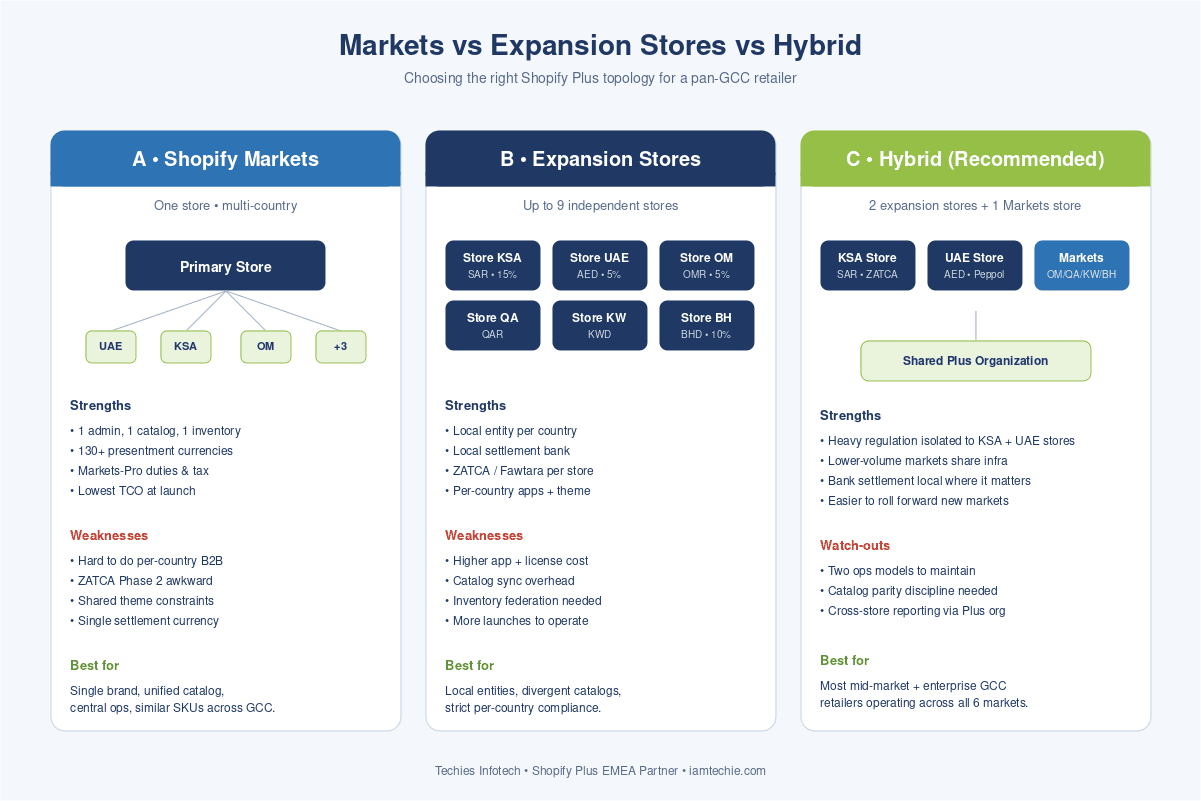
Shopify Plus gives you two primary expansion primitives and the architectural choice between them dictates almost everything downstream — from your tax engine integration to your URL structure, to where Arabic content lives.
Option A: Single Store + Shopify Markets
Shopify Markets allows one primary store to serve 130+ currencies, multiple languages, country-specific catalogs, and country-specific domains — all from a single admin. For a GCC retailer with a unified brand, similar catalog across countries, and one central operations team, this is often the cleanest starting point. You get one product catalog, one customer database, one inventory source of truth, and per-market pricing, tax and language overrides.
Option B: Expansion Stores
Shopify Plus includes up to nine expansion stores beyond the primary store. Each expansion store is an entirely independent Shopify instance — separate admin, separate apps, separate theme, separate checkout, separate payment configuration — all governed under one Plus organisation. For GCC, expansion stores are appropriate when:
- Local entities are legally distinct (a Saudi LLC versus a UAE FZ-LLC)
- Local product catalogs diverge significantly
- Settlement currencies must be local (SAR settled to a Saudi bank, AED settled to an Emirati bank)
- A market requires a dedicated app stack such as ZATCA-certified e-invoicing connectors
Option C: The Hybrid That Most Large GCC Retailers Actually Run
In practice, the most resilient pattern is a hybrid: one expansion store per country with material complexity (Saudi Arabia is almost always its own expansion store, frequently the UAE too), and a Markets-driven secondary store grouping lower-volume markets such as Oman, Qatar, Kuwait and Bahrain. This contains complexity where it matters and avoids carrying nine full storefronts where three would do.
Topology Decision Matrix
| Driver | Use Markets | Use Expansion Store | Hybrid |
|---|---|---|---|
| Legal entities | Single entity selling cross-border | Separate local entity per country | Mix of local + cross-border markets |
| Settlement currency | Single settlement currency acceptable | Must settle SAR / AED / OMR locally | Saudi + UAE local, others cross-border |
| Catalog variance | 90%+ catalog overlap | Materially different SKUs per country | Core catalog + per-country exclusives |
| E-invoicing posture | Middleware can route by market | Need ZATCA-certified per-store app | Per-store app for KSA + middleware for rest |
| Ops headcount | Lean central team | Local in-market merchandising teams | Hub team + local KSA/UAE merchants |
A Reference Architecture for a Pan-GCC Shopify Plus Retailer
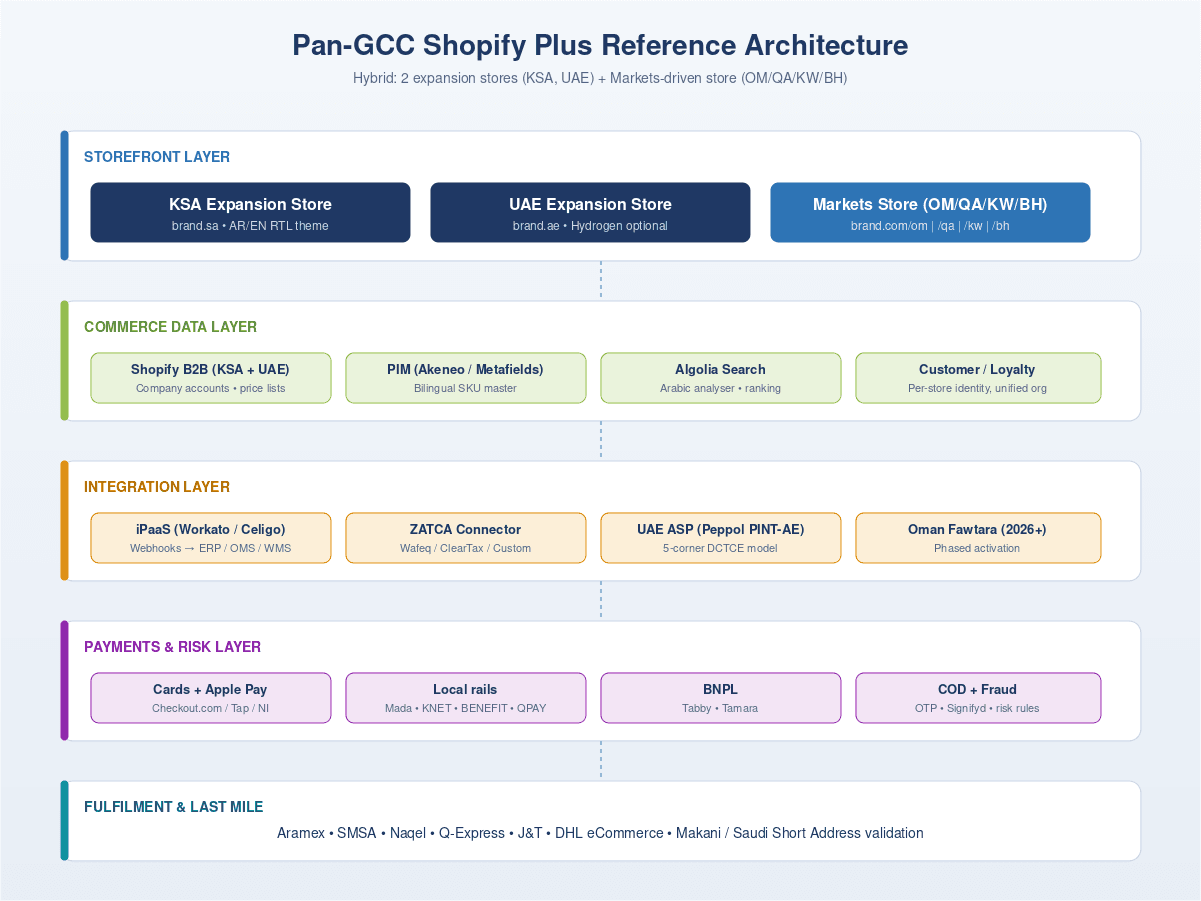
The following reference stack is the configuration we have validated repeatedly with GCC merchants across fashion, electronics, outdoor and home categories. It assumes a hybrid topology with a Saudi expansion store, a UAE expansion store, and a Markets-driven secondary store covering Oman, Qatar, Kuwait and Bahrain.
Storefront Layer
- Shopify Plus organisation with three stores: KSA (sar.brand.sa), UAE (ae.brand.com), and a Markets store serving OM, QA, KW, BH on a single .com domain with country sub-paths or sub-domains.
- Bilingual Online Store 2.0 theme with full RTL mirroring, Arabic typography (Noto Sans Arabic, Cairo or IBM Plex Sans Arabic), and locale-aware metafield rendering.
- Optional Hydrogen/Oxygen headless layer for the UAE store where conversion-rate optimisation and PWA-grade performance justify the additional engineering investment.
Commerce Data Layer
- Per-store product catalogs synced from a central PIM (Akeneo, Plytix or a Shopify metafield-driven golden record) to ensure SKU, GTIN and Arabic attribute parity.
- Shopify B2B for wholesale customers in the UAE and KSA, with company-level catalogs, price lists in AED and SAR, and net-terms payment.
- Search and discovery via Algoliaconfigured with Arabic analysers, transliteration, and personalised ranking by market.
Integration Layer
- iPaaS (Workato, Celigo, or a lightweight Node/Hydrogen middleware) brokering Shopify webhooks to ERP (NetSuite, Microsoft Dynamics 365, Odoo or SAP), WMS, OMS and the tax engine.
- ZATCA-certified e-invoicing connector for the KSA store. UAE e-invoicing via an Accredited Service Provider (ASP) on the Peppol PINT-AE network for July 2026 readiness.
- Fawtara-ready connector for the Oman store, with phased activation aligned to August 2026 onwards.
Payments and Risk Layer
- Tap Payments or Checkout.com as the primary gateway for cards, Apple Pay, Mada (KSA), KNET (KW) and BENEFIT (BH).
- Tabby and Tamara as native BNPL apps installed per store, with per-country eligibility rules.
- Shopify Payments where available; PayTabs or Telr as fallback in markets where Shopify Payments is not yet supported.
- Signifyd, NoFraud or a custom rules engine for COD fraud screening — cash-on-delivery is still 20–35% of orders in tier-two GCC cities.
Fulfilment and Last-Mile Layer
- Aramex, SMSA, Naqel, Q-Express, J&T and DHL eCommerce APIs orchestrated through a single OMS, with per-country preferred carrier routing.
- Address validation tuned for the Saudi National Address (Short Address) format, the Emirates Makani number, and free-text Arabic addresses common in Oman and Bahrain.
Country-by-Country Compliance Stack
Each GCC country has distinct technical obligations that map to specific configuration choices inside Shopify Plus. The following is the minimum compliance and localisation stack we recommend per market as of 2026.
Per-Market Compliance Snapshot
| Country | VAT | E-invoicing | Local payments | Data / consumer law |
|---|---|---|---|---|
| UAE | 5% | Peppol PINT-AE via ASP, mandatory from 31 Jul 2026 (Phase 1) | Apple Pay, Mada-cross, Tabby, Tamara, Network International, Checkout.com | UAE PDPL, DIFC DPL, ADGM DPR |
| Saudi Arabia | 15% | ZATCA Fatoora Phase 2 clearance model, XML + QR + PKI signature | Mada, Apple Pay, Tabby, Tamara, STC Pay, urpay | KSA PDPL (enforced Sep 2024), SDAIA oversight |
| Oman | 5% | Fawtara e-invoicing, phased from Aug 2026 | Thawani, OmanNet, Apple Pay, Tabby | Personal Data Protection Law (Royal Decree 6/2022) |
| Qatar | None yet | No mandate yet; GTA consulting on rollout | QPAY, NAPS, Apple Pay, Tabby | Law No. 13 of 2016 on personal data privacy |
| Kuwait | None yet | No mandate yet | KNET, Apple Pay, Tabby, Tap Payments | Data Privacy Protection Regulation 2021 |
| Bahrain | 10% | No mandate yet; NBR signalling future rollout | BENEFIT, Apple Pay, Tabby, Tap Payments | Personal Data Protection Law 30/2018 |
United Arab Emirates
The UAE store must be Peppol PINT-AE ready for the Federal Tax Authority's Decentralized Continuous Transaction Control and Exchange (DCTCE) five-corner model. From 31 July 2026, taxpayers with revenue above AED 50 million and government entities must transmit invoices in structured XML through an Accredited Service Provider (ASP). Mid-sized businesses follow in January 2027 and the remainder by July 2027. Practically, this means selecting an ASP early, mapping every Shopify order, refund and tax adjustment to UAE Ministerial Decisions 243 and 244 of 2025, and wiring webhook-driven invoice generation through the ASP rather than emitting invoices directly from Shopify.
For UI/UX, RTL mirroring should be tested on Arabic-default first, English second. Our case study on Adventure HQ and our work with Forever 21 UAE illustrate how bilingual theme architecture and Arabic content quality directly influence conversion.
Saudi Arabia
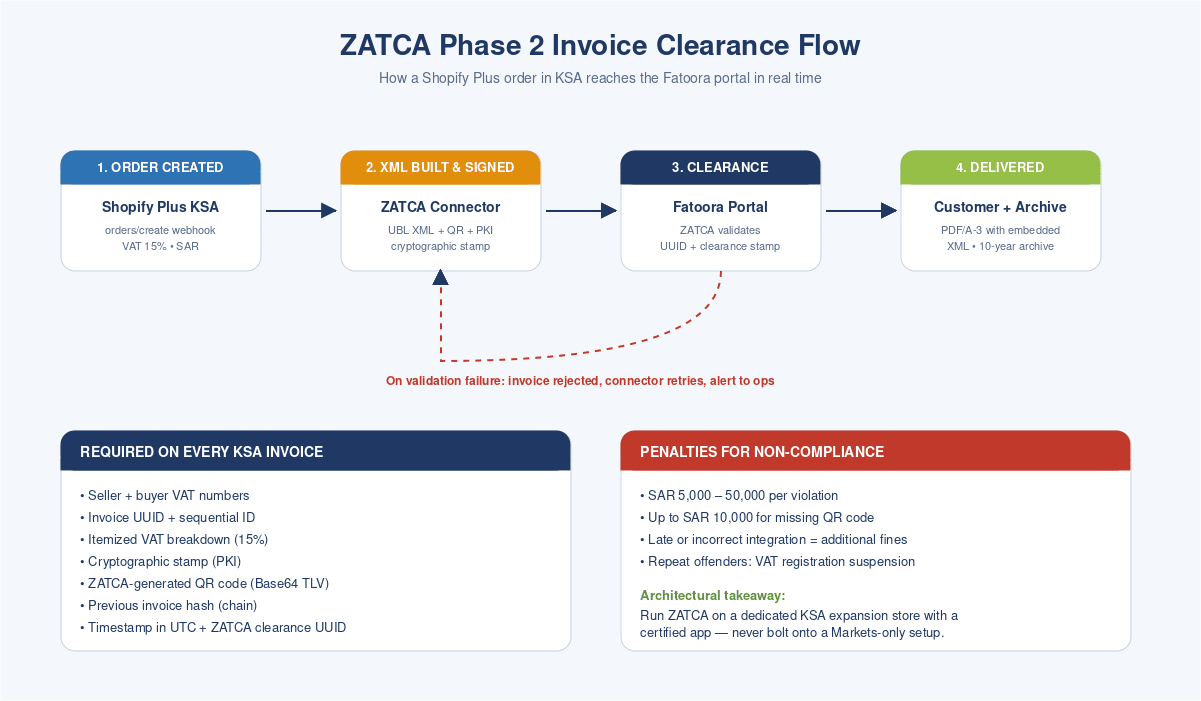
Saudi Arabia is the most regulation-heavy market in the GCC. ZATCA Phase 2 (Integration) is a clearance model: every B2B invoice must be signed with a PKI-issued cryptographic stamp, transmitted to the Fatoora portal in real time, and only returned to the customer after ZATCA validation. B2C simplified invoices must include a QR code, a digital signature and prescribed XML fields. As of 2026, the wave threshold has dropped to SAR 750,000 in annual turnover. Penalties for non-compliance range from SAR 5,000 to SAR 50,000 per violation, with VAT registration suspension possible for repeat offenders.
Inside Shopify Plus, this almost always means a dedicated KSA expansion store with a ZATCA-certified app such as Wafeq, ClearTax, Zoho Books or a custom middleware. Address handling must support the Saudi National Address Short Address format.
Oman
Oman is moving fast. The Fawtara e-invoicing initiative begins its phased rollout from August 2026, expanding to all VAT-registered businesses by August 2028. In Q1 2026 the Oman Tax Authority opens a service provider registration portal; testing follows in Q2 2026; and from Q3 2026 the OTA commences invoice exchange and receiving. Mandatory technical requirements include structured XML, supplier and buyer identification fields, automated validation, unique invoice identifiers, digital hashes and timestamps, and 10-year electronic archiving.
Our work with Muscat Duty Free on a next-generation Oman shopping platform is a current reference for how to build an Oman storefront with a forward-compatible compliance posture.
Qatar, Kuwait and Bahrain
Qatar and Kuwait have not yet introduced VAT. Bahrain has 10% VAT but no live e-invoicing mandate. For these three markets, the compliance focus is on consumer protection law, data residency, Arabic-first localisation and acceptance of local payment rails — BENEFIT in Bahrain, KNET in Kuwait, and QPAY/NAPS in Qatar. Architecturally, these markets can comfortably share a single Markets-driven storefront with country-specific URLs, currencies, tax registration toggles, and shipping configurations, with a clear migration path to dedicated expansion stores when VAT or e-invoicing arrives.
Multi-Currency Operations: Beyond Currency Conversion
Shopify Markets supports 130+ presentment currencies with automatic FX conversion via Shopify Payments, but for serious GCC operations the conversation goes further than the FX rate. Multi-currency is a pricing, tax, rounding, settlement, accounting and reconciliation problem.
Presentment vs. Settlement Currency
An order placed in SAR on the Saudi store should ideally settle into a Saudi bank account in SAR. An order placed in OMR on the Oman Market should either settle locally or, if cross-border, be converted with a transparent FX policy. The architectural decision: which currencies require local settlement (regulatory and banking driver), and which can settle to a hub account in AED, USD or EUR.
Tax-Inclusive vs. Tax-Exclusive Pricing
GCC B2C buyers expect VAT-inclusive prices on the product detail page. GCC B2B buyers expect VAT-exclusive prices with VAT added at checkout. Shopify supports both via the Markets tax behaviour toggle, but you must explicitly configure tax behaviour per market and per customer segment. Misconfiguration here is the single most common compliance error we see during audits.
Rounding Rules and Price Parity
The Kuwaiti dinar (KWD) and the Bahraini dinar (BHD) use three decimal places. The Omani rial (OMR) also uses three decimals. AED, SAR and QAR use two. Naive currency conversion without explicit rounding rules produces prices like KWD 12.347, which fails psychological pricing and confuses checkout. Use Shopify's price rounding rules per market: round to the nearest 0.250 in KWD, the nearest 0.100 in OMR, the nearest 1 in AED for round-figure SKUs.
FX Hedging and Reconciliation
For brands with material cross-border revenue, finance teams need a daily reconciliation between Shopify order currency, Shopify payout currency, ERP base currency and bank statement currency. Build this into the integration layer from day one. Retrofitting reconciliation after launch is painful.
Payments, Fraud and Checkout Localisation
Checkout is where pan-GCC architecture either succeeds or fails. A 2% improvement in checkout completion across six markets is the difference between a profitable and an unprofitable expansion.
Local Payment Methods Are Non-Negotiable
Mada accounts for the majority of Saudi card transactions, KNET dominates Kuwait, BENEFIT dominates Bahrain. Tap Payments, Checkout.com, PayTabs and Network International each support these rails with a single integration. Shopify Payments is the simplest path where available, but it is not available in all GCC countries — design the architecture to fall back gracefully to a regional gateway per store.
Buy-Now-Pay-Later Is Now Mainstream
Tabby and Tamara collectively represent 20–30% of fashion and electronics checkout volume in KSA and the UAE. Both have official Shopify apps and Shopify Plus partners. Install per expansion store, configure per-country eligibility, surface the BNPL price on product pages, and treat BNPL approval as part of checkout UX.
Apple Pay Is a Conversion Lever, Not a Nice-to-Have
iOS penetration in the UAE and KSA is among the highest in the world. Enable Apple Pay on every store, configure the merchant domain, and place the Apple Pay button above the email field on the cart page.
Cash-on-Delivery Requires a Fraud Strategy
COD failure rates in tier-two GCC cities can exceed 25%. Add a phone OTP verification step, an address validation step, and a per-customer COD eligibility rule based on order history. Signifyd, NoFraud or a custom rules engine can score and auto-reject high-risk COD orders before they reach the warehouse.
Headless, Hydrogen and Performance for Arabic Storefronts
Arabic web pages tend to be heavier than English equivalents because of font subsetting requirements, bidirectional layout calculation, and the need to load both Arabic and Latin glyphs simultaneously. Core Web Vitals in the GCC are also measured on a mobile-heavy traffic mix with a high proportion of mid-range Android devices. This combination makes performance engineering non-optional.
- Use Shopify Hydrogen and Oxygen for high-traffic storefronts where a custom React frontend and edge rendering deliver materially better LCP and INP than Online Store 2.0.
- Subset Arabic fonts to the actual character ranges used. Cairo, IBM Plex Sans Arabic and Noto Sans Arabic all support subsetting; the full font file is rarely needed.
- Lazy-load Arabic and Latin script bundles independently. A buyer browsing the English store should not download the Arabic glyph file.
- Cache the Markets selector and language toggle aggressively on the CDN edge; do not re-render on every navigation.
Performance directly impacts organic traffic and conversion. Our SEO practice has documented how Arabic-first technical SEO, hreflang configuration, and Core Web Vitals improvements move rankings across .ae, .sa and .com.kw domains.
Common Pitfalls We See in GCC Shopify Plus Programs
- Treating Arabic as a translation rather than a market. Real Arabic-first storefronts require RTL theme work, Arabic SEO templates, Arabic metafields, and Arabic-native checkout copy — not just a translated string file.
- Launching the Saudi store without ZATCA-certified e-invoicing wired into order creation webhooks. Retrofitting this after launch under live transaction load is high-risk.
- Using a single Markets store for KSA because it is simpler in week one — then discovering in month three that settlement, B2B pricing and e-invoicing complexity require a separate expansion store anyway.
- Hard-coding KWD and OMR price displays to two decimals, breaking checkout for local buyers.
- Configuring a single tax behaviour (inclusive or exclusive) globally instead of per market and per customer segment.
- Underestimating COD fraud. A naive COD configuration in Saudi tier-two cities can wipe out the margin gained from accepting COD in the first place.
- Skipping the data residency conversation. Shopify is a global SaaS — for sensitive sectors (regulated finance, healthcare-adjacent retail) this conversation matters and should happen before launch, not after.
A Staged Rollout Plan for a GCC Shopify Plus Program
A realistic implementation timeline for a hybrid pan-GCC Shopify Plus build is 16 to 24 weeks for the first store, with subsequent stores or Markets coming online in 4 to 8 week sprints.
Discovery & Planning
Topology decision (Markets vs expansion stores vs hybrid), tax engine and ASP selection, ERP integration design, ZATCA app selection.
Architecture & Build
Theme architecture (RTL + LTR), Hydrogen scoping if applicable, PIM and catalog work, payment gateway sandbox integration.
First Store Hardening
KSA usually first because of regulatory complexity — UAT with finance, tax, legal and operations stakeholders.
Soft Launch & Monitoring
Monitored ramp, finance reconciliation validation, ZATCA clearance success-rate monitoring.
Roll Forward
UAE store, then Markets-driven secondary store for OM, QA, KW, BH.
Frequently Asked Questions
1. Should a GCC retailer use Shopify Markets or expansion stores?
Markets is the right starting point for a single brand with a unified catalog and one operations team. Expansion stores are required when local legal entities, local settlement currencies, materially divergent catalogs, or country-specific compliance apps (such as ZATCA-certified e-invoicing) are in play. Most large GCC retailers run a hybrid: dedicated expansion stores for KSA and the UAE, plus a Markets-driven store for the smaller markets.
2. Is Shopify Plus ZATCA compliant out of the box?
No. Shopify Plus is not itself ZATCA-certified — it is a commerce platform, not an e-invoicing solution. You must integrate a ZATCA-certified app (such as Wafeq, ClearTax, Zoho Books or a custom middleware connected to an ASP) that signs, transmits and stores invoices in the Phase 2 Integration model. The integration is webhook-driven on Shopify's order create, fulfilment and refund events.
3. How does the UAE e-invoicing mandate affect Shopify Plus stores?
From 31 July 2026, large taxpayers and government entities must issue structured XML invoices transmitted through a UAE-Accredited Service Provider on the Peppol PINT-AE network using a five-corner DCTCE model. Mid-sized businesses follow in January 2027, the rest by July 2027. B2B and B2G are in scope; B2C is currently excluded. Architecturally, you select an ASP, route Shopify order data to the ASP via middleware, and let the ASP handle Peppol transmission.
4. Can one Shopify Plus checkout handle Mada, KNET, BENEFIT, Tabby and Tamara?
Yes, through a combination of regional gateways and BNPL apps. Tap Payments and Checkout.com support Mada, KNET and BENEFIT in a single integration. Tabby and Tamara install as separate Shopify apps. You typically configure per-store, not per-organisation, because eligibility and rails differ per country.
5. What are the typical performance targets for an Arabic Shopify Plus storefront?
Aim for an LCP under 2.5 seconds on a mid-range Android device on 4G, an INP under 200 milliseconds, and a CLS under 0.1. Arabic theme bundles must be subsetted; lazy-load scripts that are not above the fold; and where possible use Shopify Hydrogen + Oxygen for the highest-traffic storefronts.
6. How long does a pan-GCC Shopify Plus implementation take?
A realistic timeline is 16–24 weeks for the first store (typically KSA), with subsequent stores or Markets launching in 4–8 week sprints. End-to-end pan-GCC programs covering all six countries usually take 9–12 months including stabilisation.
Conclusion: One Platform, Six Markets, Zero Compromises
GCC retail is at an inflection point. The combination of ZATCA Phase 2 in Saudi Arabia, UAE Peppol e-invoicing in mid-2026, Oman's Fawtara, enforced data protection regimes, and an increasingly sophisticated consumer base means that ad-hoc, country-by-country commerce stacks no longer scale. Shopify Plus, configured deliberately with the right balance of Markets and expansion stores, integrated with the right ASPs, payment rails and tax engines, gives mid-market and enterprise GCC retailers a single platform that can hold up under all six regimes — without sacrificing performance, brand consistency, or operational sanity.
Post Tags :

Transform Your Vision into Digital Reality
Innovative Web & App Solutions Designed to Drive Growth, Efficiency, and Success for Your Business.
Categories
Tech insights and expert perspectives on thefuture of technology and eCommerce
Tech insights and expert perspectives on the future of technology and eCommerce

Let's Connect