

Why KSA Enterprise Retailers Are Migrating from Magento to Shopify Plus in 2026


A Technical & Compliance Guide for CIOs, Heads of Digital, and E-commerce Directors
The Saudi Arabian e-commerce market is set to cross USD 31.29 billion in 2026 and is on a trajectory to reach USD 54.87 billion by 2031, growing at a 11.92% CAGR powered by Vision 2030, 99% internet penetration, and 78% 5G coverage. But under the surface of this expansion, a quieter shift is reshaping enterprise retail in the Kingdom: a wave of mid-market and Tier-1 retailers are replatforming from Magento (Adobe Commerce) to Shopify Plus.
This is not a fashion trend. It is the predictable outcome of three converging forces in 2026 — escalating ZATCA Phase 2 integration obligations now reaching Waves 23 and 24, active enforcement of the Personal Data Protection Law (PDPL) by SDAIA, and a sharp rise in the total cost of ownership of self-hosted Magento estates that were stitched together over the last five years.
This guide unpacks the technical, regulatory, and commercial reasons behind the migration, and lays out a compliance-first replatforming blueprint specifically engineered for the KSA market. If you are a CIO, Head of Digital, or Director of E-commerce evaluating your platform roadmap, this is the deep-dive your steering committee needs before approving a 2026–2027 replatform.
The 2026 Inflection Point: Why Now
For most of the last decade, Magento was the default answer for ambitious KSA retailers. It offered code-level control, customisation depth, and a large local talent pool. That logic is breaking down in 2026 for four converging reasons.
1. The regulatory clock is loud. ZATCA's Phase 2 (Integration) rollout has crossed Wave 23 (deadline 31 March 2026) and Wave 24 (deadline 30 June 2026) — sweeping virtually every mid-market and SME retailer with revenue above SAR 375,000 into the mandatory clearance regime. On top of that, the PDPL is now in active enforcement, with SDAIA having issued more than 48 formal enforcement decisions as of early 2026.
2. Magento's TCO has quietly doubled. A mid-sized Magento Open Source store now consumes USD 50,000–150,000 per year in hosting, security patching, extension licensing, and developer time. Adobe Commerce license fees alone start at ~USD 22,000/year and scale with GMV, before hosting and engineering. Combined with the local KSA premium for ZATCA-certified middleware and Arabic-RTL UX work, many enterprise retailers are running USD 200,000+ all-in annually for a platform that used to cost a fraction of that.
3. Talent is leaving the Magento ecosystem. PHP/Magento 2 specialists are increasingly rare in the GCC, while Shopify Liquid, Hydrogen, and Remix developers — and AI-augmented frontend engineers — are abundant and faster to hire.
4. Speed to market is now a board KPI. Vision 2030 retail brands are launching new categories, marketplaces, B2B portals, and cross-border storefronts on quarterly cycles. Eight-week sprints replace twelve-month roadmaps, and the platform decision must keep pace.
If you want a deeper preview of the compliance landscape before reading on, our breakdown of How to Implement ZATCA API Integration Without Disrupting Your Commerce Platform is required reading for any technical owner.
The KSA Compliance Stack: What Every Enterprise Platform Must Support in 2026
Any platform decision in 2026 starts with one question — can it carry the compliance load without bolt-on fragility? Here is the non-negotiable stack a KSA enterprise retailer must support.
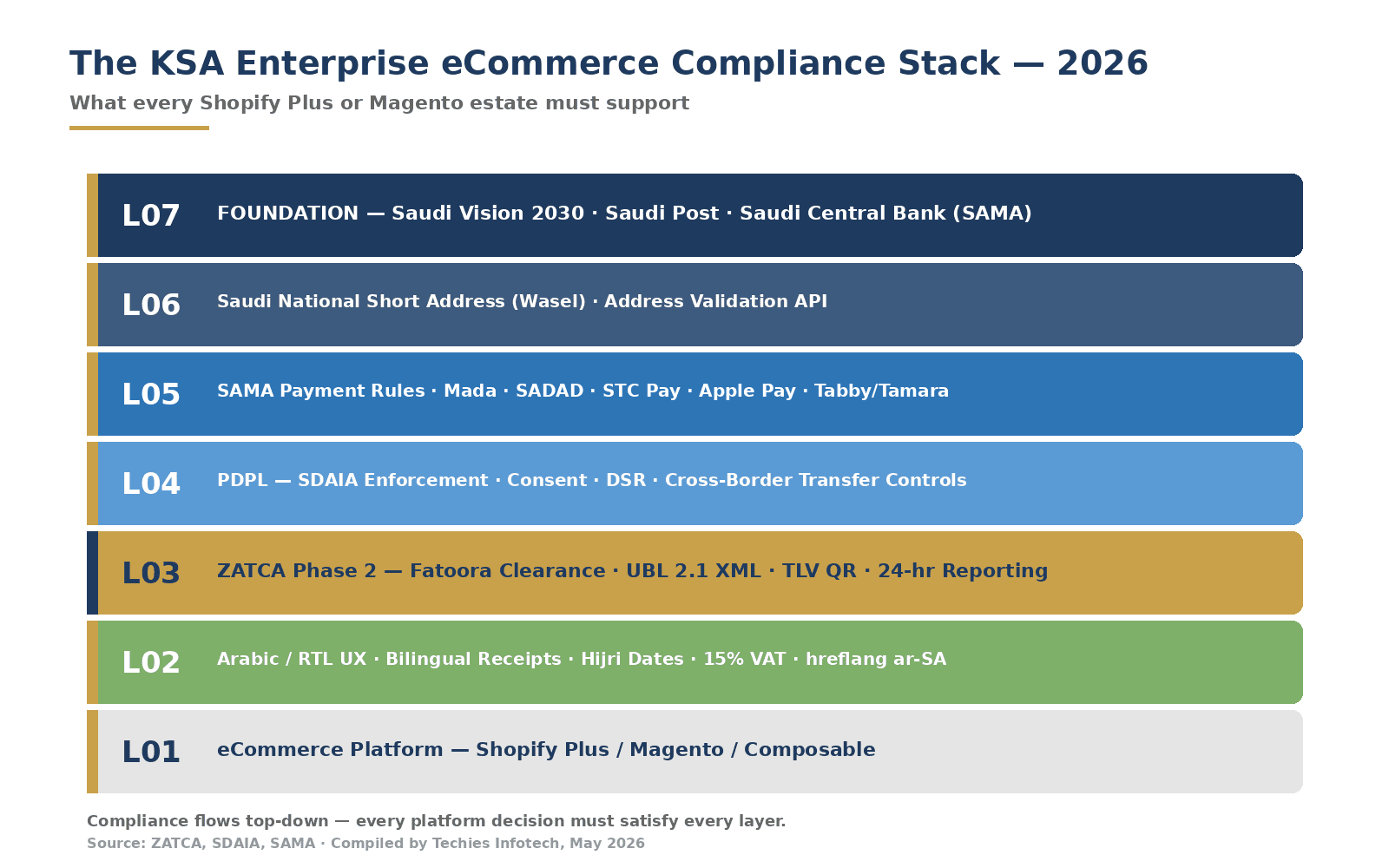
ZATCA Phase 2 — Integration & Clearance
Phase 2 of the Saudi e-invoicing framework requires a real-time clearance model for B2B and B2G invoices and a reporting model for B2C transactions. Practically, this means:
- Invoices must be generated in XML UBL 2.1 or PDF/A-3 with embedded XML.
- B2B/B2G invoices must be submitted to the Fatoora platform, cryptographically stamped by ZATCA, and only then delivered to the customer.
- B2C simplified tax invoices must carry a TLV QR code and cryptographic stamp, and be reported to Fatoora within 24 hours.
- Onboarding requires CSR generation, OTP-based CSID issuance, and ongoing PCSID renewal.
- Integration must be resilient to ZATCA platform outages, with queue-and-retry semantics, signed audit logs, and reconciliation dashboards.
Wave 23 covers all taxpayers with revenue above SAR 750,000 in 2022, 2023, or 2024. Wave 24 lowers the threshold to SAR 375,000 — effectively pulling every meaningful retailer into scope by H2 2026.
Personal Data Protection Law (PDPL)
The PDPL has been fully enforceable since September 2024, and 2026 marks the first year of sustained enforcement by SDAIA. For e-commerce, the key obligations are:
- Lawful basis & consent for collecting and processing personal data, including marketing consent (a top enforcement area in 2026).
- Cross-border transfer controls — controllers must use Standard Contractual Clauses or Binding Corporate Rules approved by SDAIA, since no "adequate country" list yet exists.
- Right to access, rectify, and delete customer data.
- Breach notification to SDAIA and to affected data subjects.
- Data Protection Officer designation for higher-risk processing.
SAMA Payment & Wallet Rules
The Saudi Central Bank (SAMA) regulates every Payment Service Provider operating in the Kingdom under the Law of Payments and Payment Services and its Implementing Regulations. Enterprise checkouts must integrate licensed PSPs and support Mada (mandatory for domestic card acceptance), SADAD, Apple Pay, STC Pay, HyperPay, PayTabs, Moyasar, Tap Payments, and increasingly Tabby and Tamara for BNPL.
Saudi National Short Address
Saudi Post's Wasel / Short Address scheme requires a structured address format combining a 4-letter code, 4-digit building number, 5-digit ZIP, and a 4-digit extension. Last-mile carriers, ZATCA invoicing, and KYC checks now expect this format. Our deep-dive on Shopify + Saudi National Short Address — Now Live for KSA Merchants explains how to validate and persist it natively.
Arabic, RTL, VAT, and Bilingual Receipts
Storefronts must serve fully bilingual Arabic-English experiences with proper dir="rtl" and lang="ar-SA" handling, hreflang tags, Hijri-aware date formats, 15% VAT computation, and bilingual tax invoices that match ZATCA's required fields.
Where Magento (Adobe Commerce) Is Breaking Down for KSA Enterprises
Magento is still a powerful platform on paper. In practice, here is what KSA enterprise teams are reporting in 2026.
Compliance Modules Are Custom, Fragile, and Expensive
Most Magento installations in KSA rely on third-party ZATCA extensions or bespoke middleware glued onto the order workflow. Every Magento core upgrade, security patch, or extension update risks breaking the cryptographic chain, the QR generation, or the queue worker — and that risk is borne entirely by the retailer.
Performance Plateaus at Scale
A typical Magento 2 estate handling KSA peak loads (Ramadan, White Friday, National Day) requires aggressive Varnish, Redis, Elasticsearch, multi-node MySQL, and message queue tuning. Page-load budgets routinely slip past 3 seconds on PDPs once you bolt on personalisation, recommendations, and the ZATCA hook. Our analysis in Why Most Shopify Search Apps Fail in the Middle East explores how even Shopify needs specific tuning for Arabic search — and Magento's burden is heavier.
TCO Has Crossed the Tipping Point
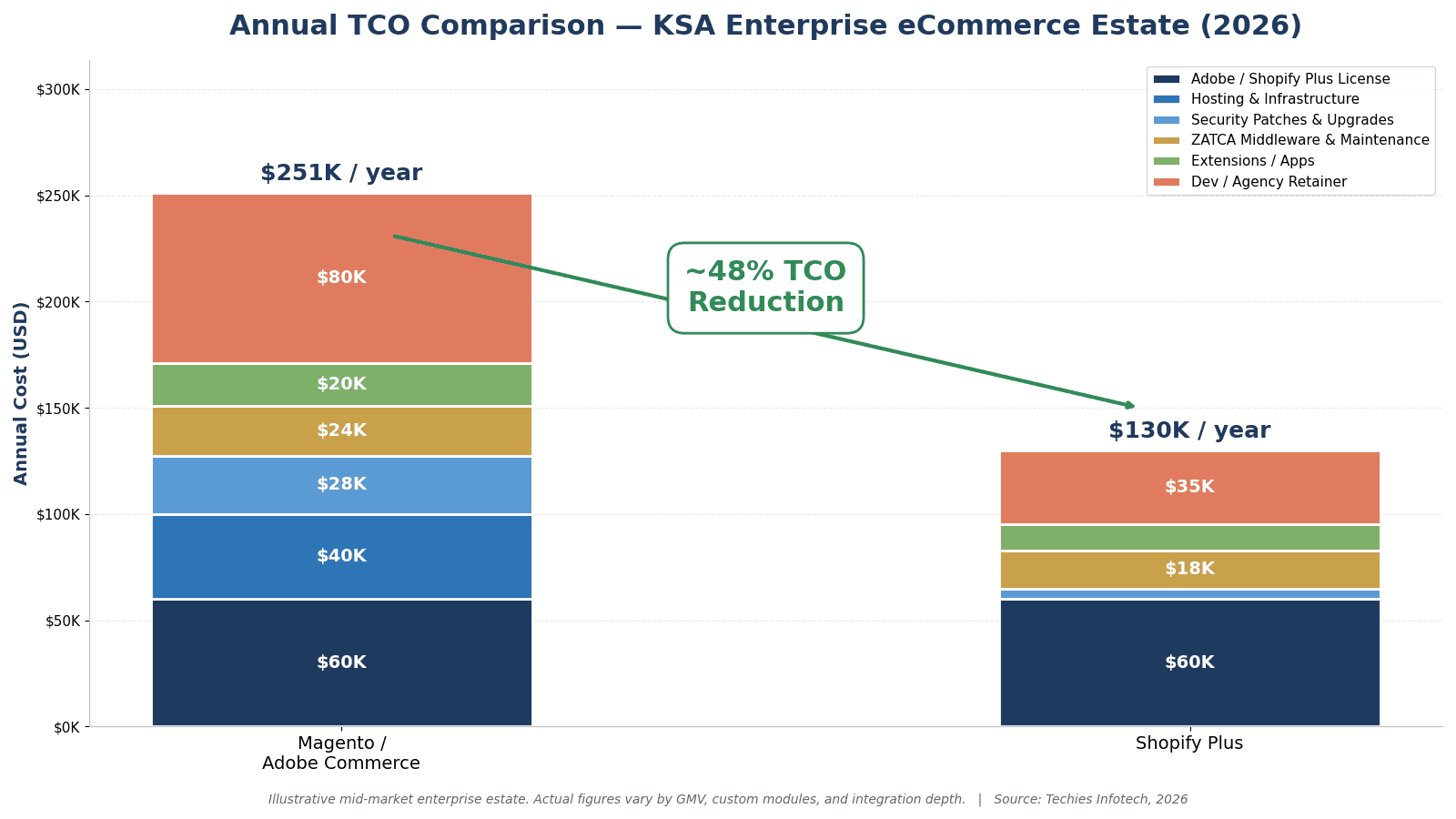
The real, all-in TCO math for a KSA enterprise Magento estate in 2026 looks like this:
| Cost Bucket | Annual Range (USD) |
|---|---|
| Adobe Commerce license (if used) | $22,000 – $190,000+ |
| Hosting & infrastructure | $20,000 – $60,000 |
| Security patches & upgrades | $15,000 – $40,000 |
| ZATCA middleware & maintenance | $12,000 – $35,000 |
| Extensions & SaaS add-ons | $10,000 – $30,000 |
| Developer/agency retainer | $40,000 – $120,000 |
| Total | $119,000 – $475,000+ |
Adobe's own lifecycle policy confirms regular support for the 2.4.6 release line ends on 11 August 2026, with extended support available only for Adobe Commerce — not Magento Open Source. For many KSA retailers, that calendar event has become the forcing function.
Talent and Innovation Velocity
Magento contributions and core innovation have slowed materially. Meanwhile, every interesting commerce capability in 2026 — agentic commerce, on-page AI search, AI merchandising, conversational checkout — is shipping first on Shopify Plus. We covered the agentic shift in Agentic Commerce Is Here: What Shopify's ChatGPT Integration Means for GCC Merchants and Enterprise Retailers
Why Shopify Plus Is Winning in 2026 KSA
Shopify Plus has matured into a genuine enterprise platform. For KSA enterprise retailers, the value compresses into five themes.
1. A Compliance-Ready Ecosystem
Shopify Plus does not natively clear invoices with ZATCA — no global SaaS does. But it provides the integration surface (Order, Fulfillment, and Tax webhooks; metafields; Functions; Flow) that allows certified ZATCA middleware to slot in cleanly without modifying core. The architectural pattern is now well-trodden by ZATCA-experienced partners. Combined with native PCI DSS Level 1, SOC 2 Type II, and ISO 27001 certifications inherited from Shopify's platform, the compliance posture is enterprise-grade out of the box. Our Shopify Plus enterprise services page covers the architecture options.
2. Native KSA Payments
Shopify Plus supports Mada via certified PSPs (HyperPay, PayTabs, Moyasar, Tap), Apple Pay, STC Pay, Tabby/Tamara BNPL, and Cash-on-Delivery with parcel-level reconciliation. A single PSP integration typically unlocks Mada, Visa, Mastercard, AMEX, and Apple Pay together — collapsing what used to be 3–4 Magento connector projects into one.
3. Multi-Storefront, B2B, and Cross-Border by Design
Shopify Plus ships with multi-store (up to 9 expansion stores), native B2B (company accounts, price lists, draft orders, NET terms), and Markets for cross-border localisation, multi-currency, and translated routing — capabilities that historically required separate Magento installations or heavy customisation.
4. Composable When You Need It
Shopify's headless stack — Hydrogen, Oxygen, Storefront API, and Functions — supports the composable architectures that Tier-1 KSA retailers increasingly demand for performance and brand differentiation. Our reference architecture in Headless Commerce with ACC: A Deep Dive into Architecture and Implementation explores the design considerations from the Adobe Commerce side, and the same principles translate directly to a Shopify Plus + Hydrogen build.
5. 40–60% TCO Reduction, 12–18 Month Payback
Industry benchmarks now consistently show 40–60% TCO reduction within the first 12 months of moving from Magento to Shopify Plus, with most mid-size brands recovering migration costs within 12–18 months. The savings come from collapsed hosting, eliminated patching cycles, fewer extensions, and a smaller (but more senior) engineering team.
A KSA-Compliant Migration Architecture (Reference Blueprint)
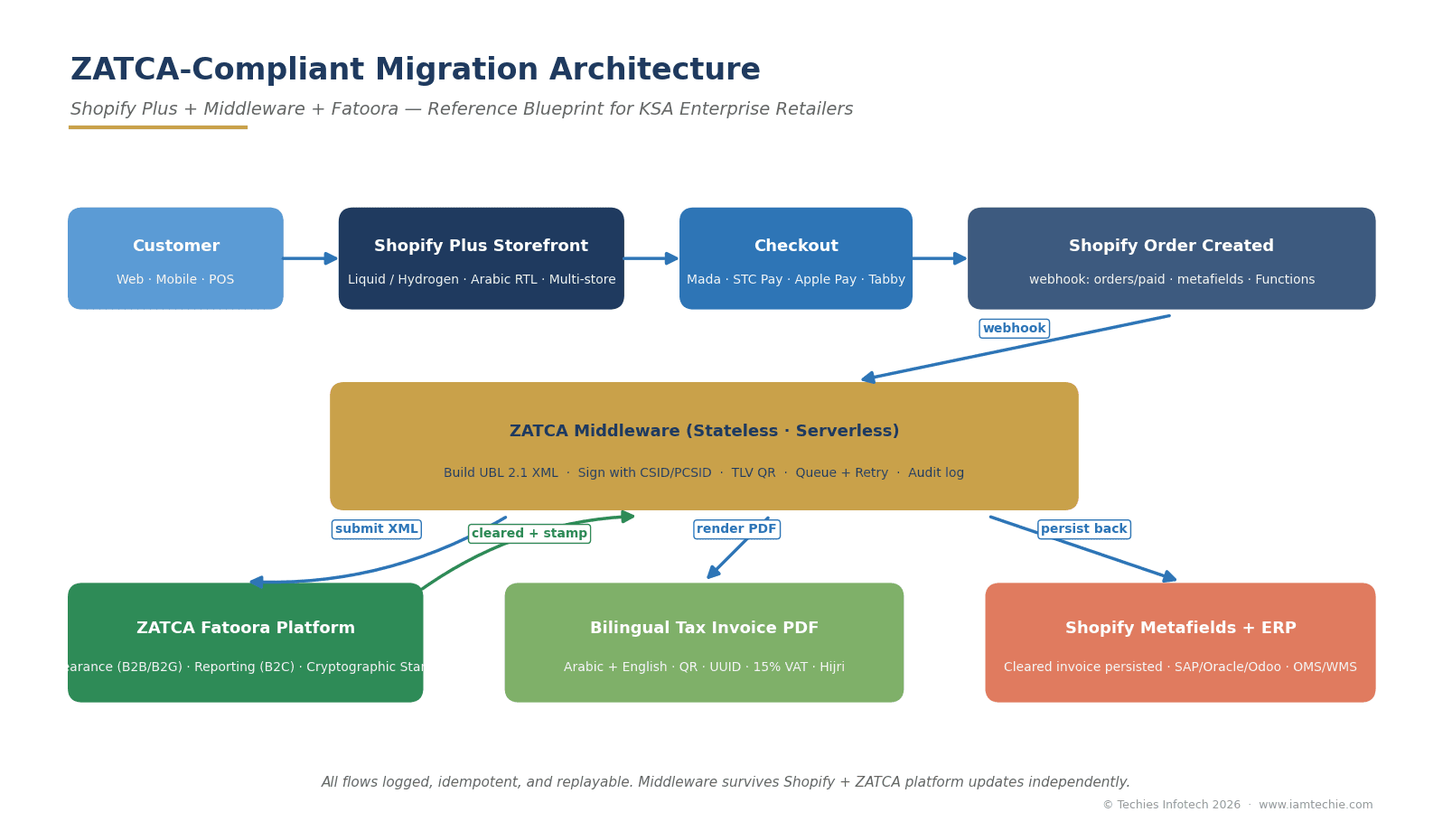
A migration from Magento to Shopify Plus in KSA is not a like-for-like swap. Done well, it is a chance to remove technical debt and re-architect for the next five years of growth. Here is the blueprint we recommend.
Phase 0 — Discovery & Compliance Mapping (2–3 weeks)
- Inventory of customisations, custom modules, ZATCA logic, KYC flows, and PSP integrations.
- Data audit: customer records, GDPR/PDPL consent state, addresses (especially Short Address compliance), order history, gift cards, loyalty balances.
- Compliance gap analysis against ZATCA Phase 2 wave deadlines and PDPL controls.
- SEO crawl, ranking baseline, redirect map planning.
Phase 1 — Architecture & Design (3–4 weeks)
- Storefront strategy: Liquid 2.0 vs. Hydrogen (headless) vs. hybrid.
- Multi-storefront and multi-currency Markets configuration (KSA / GCC / Global).
- ZATCA middleware design — typically a stateless serverless service that listens to Shopify
orders/paidwebhooks, builds the UBL 2.1 invoice, submits to Fatoora, persists the cleared invoice + QR + UUID into a Shopify metafield, and triggers the bilingual PDF. - PDPL data map and cross-border transfer assessment.
- Integration topology — ERP (SAP/Oracle/Odoo), OMS, WMS, PIM, CDP, loyalty.
Phase 2 — Build & Data Migration (6–10 weeks)
- Theme/Hydrogen build with full Arabic RTL support, bilingual product data, Hijri-aware date components.
- Catalog, customer, and order migration via Shopify's Bulk Operations API and Transporter pattern. Hash-and-compare validation between Magento and Shopify exports.
- Customer password rehashing strategy (forced reset on first login is the simplest PDPL-friendly path).
- App selection and configuration: review apps, search (Algolia, Klevu), reviews, loyalty, BNPL, CRO.
Phase 3 — Compliance Hardening & QA (3–4 weeks)
- End-to-end ZATCA clearance test against sandbox and pre-production.
- PDPL consent capture and preference centre validation.
- Penetration test, OWASP Top 10 sweep, rate-limit review.
- Performance test against 10× peak load, with Arabic-language pages in scope.
Phase 4 — Launch & Hypercare (4 weeks)
- DNS cutover with phased traffic shift.
- 301 redirect map deployment and Google Search Console submission.
- Real-time monitoring of ZATCA queue, payment failure rates, conversion funnel.
- Daily war-room cadence for the first 2 weeks, weekly thereafter.
For brands that need this discipline plus an enterprise SLA wrapper, our enterprise eCommerce engineering practice runs migrations of this shape across KSA and the GCC.
SEO Preservation: A Replatform's Silent Killer
A KSA replatform that drops 30% of organic traffic in the first 60 days has destroyed value before the new platform has shipped a single feature. The non-negotiables:
- 1:1 URL redirect map with HTTP 301s — generated from a crawl of indexed URLs, not a CMS export.
- Preservation of canonical, hreflang (
ar-SA,en-SA,x-default), and structured data (Product, BreadcrumbList, Organization, FAQPage). - Identical or improved Core Web Vitals on launch day — Shopify Plus typically wins here, but only if Liquid is written with care.
- Reindex submission and a 30-day post-launch monitoring window for crawl errors and ranking drift.
What the Real World Looks Like: A KSA Reference Build
We architected and delivered a middleware-driven Shopify Plus ecosystem for Steve Madden's UAE & KSA business, automating order, inventory, and compliance workflows while meeting stringent regulatory requirements including ZATCA e-invoicing and Saudi National Address validation. The architecture handles bilingual invoicing, multi-warehouse fulfillment, RTL UX, and a composable middleware that survives Shopify and ZATCA platform updates independently — exactly the pattern most KSA enterprises now need. The full breakdown lives in our Steve Madden KSA and UAE case study.
Similar patterns play out in our Kanaa composable commerce case study, which shows what API-driven infrastructure looks like for a high-growth KSA toys-and-leisure brand, and the Adventure HQ Shopify build that demonstrates the speed-to-market angle.
Migration Risks and How to De-risk Them
| Risk | Mitigation |
|---|---|
| ZATCA outage during clearance | Asynchronous queue with retry + dead-letter alerting; cache CSID/PCSID |
| Customer password loss | Forced reset with PDPL-compliant email; phased rollout |
| SEO traffic drop | Pre-launch redirect map, hreflang, indexable Arabic alternates |
| Loyalty / wallet balance mismatch | Snapshot + reconcile via API, freeze window during cutover |
| PSP downtime during cutover | Dual PSP routing for first 30 days |
| Custom Magento module loss | Re-implement in Shopify Functions or middleware; deprecate dead features |
| ERP/OMS integration regression | Contract tests, idempotency keys, replay logs |
A serious KSA migration plan accounts for each of these in the SoW — not as risk register entries discovered during QA.
What This Means for Your 2026–2027 Roadmap
If you are operating a Magento or Adobe Commerce estate in the Kingdom today, the decision matrix in 2026 is sharper than it has ever been. Continuing on Magento is defensible only if you have a strategic reason (deep B2B complexity, niche ERP coupling, a large in-house Magento team that genuinely delivers) and a credible plan to fund the ongoing TCO. For most KSA enterprise retailers — particularly those facing Wave 23/24 deadlines, active PDPL exposure, and a refresh of their multi-storefront strategy — Shopify Plus is now the lower-risk, lower-cost, faster-innovation path.
The retailers winning in KSA in 2026 are not those with the most features. They are those who can ship compliance-grade releases on a monthly cadence, run experiments without engineering bottlenecks, and let the platform absorb the regulatory burden instead of inheriting it.
Frequently Asked Questions
Q1
Is Shopify Plus officially compliant with ZATCA in Saudi Arabia?
Shopify Plus does not clear invoices with ZATCA natively — no global SaaS platform does. Compliance is achieved through certified middleware that consumes Shopify webhooks, generates UBL 2.1 invoices, integrates with the Fatoora platform, and writes the cleared invoice, QR, and UUID back to Shopify. With a well-architected middleware layer, Shopify Plus retailers in KSA can fully meet ZATCA Phase 2 clearance and reporting requirements.
Q2
How long does a typical Magento to Shopify Plus migration take in KSA?
A clean catalog with a focused theme migrates in 8 weeks. A complex B2B + DTC + multi-storefront enterprise build with ZATCA middleware, ERP integration, and Arabic RTL UX typically takes 12–20 weeks. Discovery and design account for the first 4–6 weeks; the rest is build, QA, and hypercare.
Q3
What is the realistic cost of a KSA enterprise Magento to Shopify Plus migration?
Mid-market migrations land in the USD 60,000–200,000 range; large enterprise programs with heavy customisation, headless front-ends, and deep integrations can extend to USD 200,000+. Most retailers recover the investment within 12–18 months through reduced hosting, patching, and engineering overhead — typically a 40–60% TCO reduction.
Q4
Will we lose SEO rankings when migrating from Magento to Shopify Plus?
Not if the migration is engineered correctly. A 1:1 redirect map, preserved hreflang and structured data, identical or improved Core Web Vitals, and a 30-day post-launch monitoring window typically result in flat-to-positive ranking trajectories. Most ranking losses come from skipped redirect mapping or missed Arabic alternates.
Q5
Can Shopify Plus handle Mada, STC Pay, and Tabby in one checkout?
Yes. A single certified PSP integration (HyperPay, PayTabs, Moyasar, or Tap) typically delivers Mada, Visa, Mastercard, AMEX, and Apple Pay together. STC Pay, Tabby, and Tamara each have their own Shopify-certified apps that plug into the standard checkout flow.
Q6
How does Shopify Plus handle the Saudi National Short Address?
With a custom checkout extension or a certified app, Shopify Plus can validate the Short Address format (4 letters + 4-digit building + 5-digit ZIP + 4-digit extension), look up the structured address via Saudi Post's API, persist it as customer metafields, and pass it through to ZATCA and the carrier. Our Saudi National Short Address guide walks through the implementation.
Q7
What happens to our PDPL consent and customer data during migration?
A compliant migration treats PDPL as a first-class workstream. Consent state, marketing preferences, and cross-border transfer flags must be migrated as discrete fields (not bundled into a generic accepts_marketing boolean). New consent should be re-captured where the lawful basis is unclear, and a re-permission email campaign is often the safest pre-launch step.
Conclusion: Migration Is a Strategic Infrastructure Decision
The migration from Magento to Shopify Plus in KSA is not driven by a feature debate. It is being driven by the convergence of ZATCA Phase 2 enforcement, PDPL maturity, talent economics, and a TCO model that no longer makes sense for most enterprise retailers. The brands that will lead KSA retail in 2027 are the ones replatforming in 2026 — with compliance, performance, and AI-readiness designed in from day one.
If you are evaluating your replatforming options or need a second opinion on a migration already in motion, our Shopify Plus engineering team and Magento Adobe Commerce specialists can run a free architecture review of your current estate.
Post Tags :

Transform Your Vision into Digital Reality
Innovative Web & App Solutions Designed to Drive Growth, Efficiency, and Success for Your Business.
Categories
Tech insights and expert perspectives on thefuture of technology and eCommerce
Tech insights and expert perspectives on the future of technology and eCommerce

Let's Connect